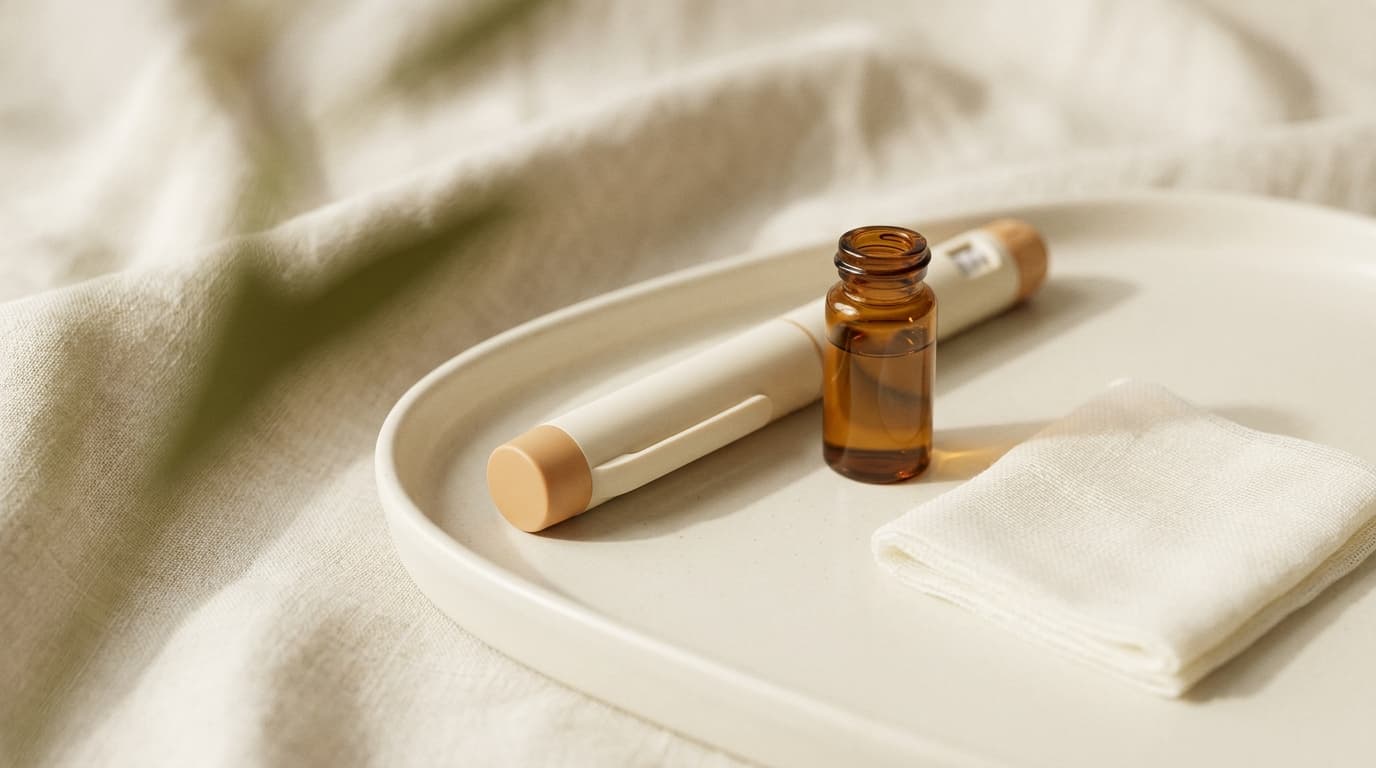
Reconstituting a 10 mg BPC-157 vial means adding a sterile diluent to make a known concentration, such as mg/mL or mcg per syringe unit. However, BPC-157 is not FDA-approved, has limited human evidence, and should not be mixed or injected without clinician guidance and a verified sterile supply chain.
Wondering if GLP-1 is right for you? Take the 3-min clinical quiz.
See if you qualify →What does it mean to reconstitute a 10 mg BPC-157 vial?
BPC-157 reconstitution means adding a sterile liquid to lyophilized peptide powder so the powder dissolves into a measured solution. The final concentration depends on how much liquid is added, not just on the vial size.
BPC-157, or Body Protection Compound 157, is an investigational peptide discussed in musculoskeletal, bladder, gut, and recovery research. Reviews describe interest in possible tissue-repair pathways, but they also stress that approved-use evidence is not established and safety questions remain 1, 3, 4.
Key terms
- Lyophilized peptide powder: freeze-dried peptide in a vial.
- Diluent: the sterile liquid added to dissolve the powder. Examples discussed online include bacteriostatic water, sterile water for injection, or normal saline.
- Concentration: how much peptide is present in each mL of liquid, usually written as mg/mL or mcg/mL.
- mcg/mL: micrograms per milliliter. Since 1 mg equals 1,000 mcg, a 10 mg vial contains 10,000 mcg.
- U-100 insulin syringe units: markings on a common syringe type. Unit-to-mcg conversion depends on the final concentration.
This math matters because a syringe marking does not mean the same thing for every vial. A “10-unit” mark on a U-100 syringe represents a volume, but the amount of peptide in that volume changes when the vial is mixed at 1 mL, 2 mL, or 5 mL.
How do you calculate concentration for a 10 mg BPC-157 vial?
For 10 mg BPC-157, concentration is calculated by dividing 10,000 mcg by the number of mL added. This is arithmetic only; it is not a dosing recommendation or injection protocol.
The basic formula is: total peptide amount ÷ diluent volume = final concentration. Because no validated human BPC-157 dose has been established, concentration math should not be used as a shortcut for self-treatment 3, 8, 9, 10.
| Educational example | Total peptide | Diluent volume | Final concentration | What this means |
|---|---|---|---|---|
| 10 mg vial mixed with 1 mL | 10,000 mcg | 1 mL | 10,000 mcg/mL | More concentrated solution; syringe marks contain more mcg per volume |
| 10 mg vial mixed with 2 mL | 10,000 mcg | 2 mL | 5,000 mcg/mL | Less concentrated than 1 mL; each same-volume syringe mark contains half as much peptide |
| 10 mg vial mixed with 5 mL | 10,000 mcg | 5 mL | 2,000 mcg/mL | More dilute solution; larger volume for the same mcg amount |
A U-100 insulin syringe is marked so that 100 units equals 1 mL. But the mcg per unit still depends on the vial concentration. That is why “how many units?” cannot be answered safely without knowing the concentration and the clinical plan.
How much water do people commonly add to a 10 mg BPC-157 vial?
Online examples for 10 mg vials often show 1–2 mL of bacteriostatic water, but those examples are not validated human instructions. They are mixing examples, not evidence-based dosing plans.
Bacteriostatic water is sterile water that contains 0.9% benzyl alcohol as a preservative. Sterile water for injection does not contain that preservative. Normal saline contains salt. Which diluent is appropriate depends on the product, route, pharmacy instructions, and clinical context.
Do not use tap water, bottled water, opened water, research-only supplies with unclear labeling, or products with missing lot numbers. Reviews of unapproved peptide therapies emphasize that product identity, purity, sterility, and safety are central concerns, especially outside regulated medical supply chains 3, 4, 6.
What are the sterile-handling risks patients should understand?
Sterility is often the biggest practical risk with self-mixed peptides. A vial can be contaminated by a nonsterile needle, repeated punctures, damaged seals, poor storage, or an unclear supply chain.
Contamination can lead to infection, inflammation, or unsafe injection reactions. BPC-157 itself also has uncertain human safety because the clinical evidence base is limited and still developing 3, 6.
Safety checklist before any injectable medication
- Use only medication and supplies from a verified medical source, such as a licensed pharmacy or clinician-directed channel.
- Confirm the label, lot number, beyond-use date, storage directions, concentration, and route.
- Use sterile needles and syringes once only, then place them in an approved sharps container.
- Clean vial stoppers and skin only as directed by a clinician or pharmacist.
- Do not use a vial if the seal is damaged, the product is unlabeled, the solution is cloudy, or particles are visible.
- Do not rely on social media videos as a sterile-preparation guide.
- Contact a clinician or pharmacist if storage was unclear, the vial warmed unexpectedly, or you notice redness, swelling, fever, severe pain, or other concerning symptoms.
If you are trying to understand safer access questions, our guide on how to get BPC-157 peptide safely explains why clinician oversight and source quality matter more than vial math.
What does the evidence say about BPC-157 in humans?
The honest answer is that human BPC-157 evidence is limited. Much of the literature is preclinical, review-based, or early human research, so benefits should not be presented as established.
BPC-157 has been studied for possible roles in soft tissue healing, angiogenesis, nitric oxide signaling, VEGF-related pathways, and inflammatory signaling. These mechanisms are mostly described in preclinical and review literature, and they do not prove clinical benefit in people 1, 3, 6.
| Claim area | Evidence level | What is known | Main limits and risks |
|---|---|---|---|
| Musculoskeletal injury and soft tissue healing | Mostly preclinical and review literature; limited human data | Reviews describe possible tissue-repair pathways and ongoing interest in sports medicine. | Not enough evidence for routine use; unapproved peptide therapies need safety and efficacy evaluation. |
| Knee pain | Human report | A published human report evaluated intra-articular BPC-157 injections for multiple types of knee pain 2. | This does not establish broad efficacy, long-term safety, or a general dosing protocol. |
| Interstitial cystitis | Pilot human study | A pilot study evaluated BPC-157 for symptoms in patients with interstitial cystitis 5. | Pilot data are not enough to establish routine care or validated dosing. |
| Hamstring strain repair | Registered clinical trial | ClinicalTrials.gov lists a Phase 2 study of BPC-157 for acute hamstring muscle strain repair 9. | A registered trial shows investigation, not proven benefit before results are available. |
| Rotator cuff repair recovery | Registered clinical trial | ClinicalTrials.gov lists a Phase 1 study of BPC-157 after rotator cuff repair surgery 10. | Early-phase trials focus on safety and feasibility; they do not validate self-use. |
If your goal is injury recovery, start with diagnosis. Tendon tears, fractures, infections, nerve compression, bladder pain, and inflammatory bowel symptoms can worsen if standard care is delayed. For related reading, see our plain-English guides to BPC-157 evidence and legal status, knee injury and treatment, and rotator cuff tendon treatment.
Is BPC-157 approved or prescribed like standard medications?
BPC-157 has no FDA-approved indication and should be viewed as an investigational peptide, not a standard approved medication. Published reviews describe BPC-157 within the broader category of unapproved peptide therapies being discussed in sports medicine and regenerative medicine 3, 4, 6.
This is why we do not recommend treating a vial label or online calculator as a care plan. The main safety question is not “how many mL fit in the vial?” It is whether the compound is appropriate at all, whether the source is verified, and whether a licensed clinician is monitoring risks.
Our article on whether you need a prescription for BPC-157 explains the difference between medical oversight, compounding questions, and research-market products. If you are comparing online sources, also read our guide to BPC-157 peptide sold online.
What should you ask a clinician before considering BPC-157?
Before considering any investigational peptide, ask whether your symptoms need a standard diagnosis first. Pain, swelling, weakness, wounds, bladder pain, or gut symptoms may need imaging, labs, physical therapy, infection treatment, or another established plan.
- What diagnosis are we treating, and what needs to be ruled out first?
- What human evidence supports this use, and what evidence is still missing?
- What are the known and unknown side effects, contraindications, and interaction risks?
- Are there better-studied options for this condition?
- How are sterility, storage, lot tracking, and adverse-event reporting handled?
- Who do I contact if I have redness, fever, swelling, worsening pain, or a reaction?
- What follow-up or monitoring would be needed?
This is especially important for injected products. Injectable peptide reviews note that physicians are seeing more patient questions about peptides, but the evidence and oversight vary widely by compound 4, 6.
What does Chia offer instead of BPC-157?
Chia does not currently offer BPC-157. We do not want readers to infer that a BPC-157 vial, reconstitution supplies, or BPC-157 prescription is available through Chia.
At Chia, we do offer other clinician-reviewed longevity and peptide-related treatments in our current catalog, when clinically appropriate after an online evaluation. These include GHK-Cu cream, glutathione injection or nasal spray, NAD+ injection or nasal spray, sermorelin injection, nasal spray, or tablets, PT-141 nasal spray, and GLP-1 weight-loss treatments such as semaglutide injection and tirzepatide tablets or injection.
Here is how Chia works for treatments we do offer: a short online health questionnaire is reviewed by a licensed US provider, who prescribes only when clinically appropriate. Medications are compounded in the US by state-licensed 503A compounding pharmacies and shipped to the patient’s door. Dosing is provider-guided and can be adjusted over time through the patient portal. Compounded medications are not FDA-approved.
| Chia treatment or protocol | Forms listed in Chia catalog | Current starting price | How it differs from BPC-157 |
|---|---|---|---|
| GHK-Cu | Cream | From $159/mo | Skin-focused peptide-related treatment offered through clinician review, not BPC-157 |
| Glutathione | Injection, nasal spray | From $179/mo | Antioxidant support option in Chia catalog, not a tissue-repair research peptide |
| NAD+ | Injection, nasal spray | From $179/mo injection; from $119/mo nasal spray | Longevity-related option with provider-guided use |
| Sermorelin | Injection, nasal spray, tablets | From $179/mo | Growth-hormone-axis peptide option in Chia catalog |
| Foundation Longevity | Sermorelin Injection + NAD+ Injection + Glutathione Injection | From $399/mo | Multi-treatment protocol; not a BPC-157 substitute or injury protocol |
If you are mainly trying to avoid research-market risks, our guide on where to get peptide injections safely explains the licensed-provider and licensed-pharmacy pathway.
Frequently asked questions about BPC-157 10 mg reconstitution
A 10 mg vial contains 10,000 mcg before any diluent is added. That is because 1 mg equals 1,000 mcg.
The concentration is 5,000 mcg/mL. The math is 10,000 mcg divided by 2 mL. This is concentration math only, not a dosing recommendation.
No validated human BPC-157 dose has been established for routine clinical use. BPC-157 is investigational, not FDA-approved for any medical indication, and should not be self-dosed from online examples.
Do not choose a diluent on your own. Bacteriostatic water, sterile water for injection, and normal saline are different products. The correct diluent depends on pharmacy instructions, product labeling, route, and clinician guidance.
There is no single safe answer for all BPC-157 vials. Storage time depends on the product, diluent, sterility, pharmacy instructions, and beyond-use dating. If those details are unclear, do not use the vial.
BPC-157 is not FDA-approved for any medical indication. Legal and compounding status can be complex, but research-market products should not be treated as prescription-quality medication.
Do not use it. Cloudiness, particles, damaged seals, missing labels, unclear concentration, or uncertain storage are reasons to stop and contact a clinician or pharmacist.
No. Chia does not currently offer BPC-157. Chia offers other clinician-reviewed treatments in its current catalog, but BPC-157 is education-only on this site.
References
- 1.Gwyer D, Wragg NM, Wilson SL. Gastric pentadecapeptide body protection compound BPC 157 and its role in accelerating musculoskeletal soft tissue healing. Cell and Tissue Research. 2019.
- 2.Lee E, Padgett B. Intra-Articular Injection of BPC 157 for Multiple Types of Knee Pain. Alternative Therapies in Health and Medicine. 2021.
- 3.Mendias CL, Awan TM. Safety and Efficacy of Approved and Unapproved Peptide Therapies for Musculoskeletal Injuries and Athletic Performance. Sports Medicine. 2026.
- 4.DeFoor MT, Dekker TJ. Injectable Therapeutic Peptides-An Adjunct to Regenerative Medicine and Sports Performance? Arthroscopy. 2025.
- 5.Lee E, Walker C, Ayadi B. Effect of BPC-157 on Symptoms in Patients with Interstitial Cystitis: A Pilot Study. Alternative Therapies in Health and Medicine. 2024.
- 6.Mayfield CK, Bolia IK, Feingold CL, et al. Injectable Peptide Therapy: A Primer for Orthopaedic and Sports Medicine Physicians. The American Journal of Sports Medicine. 2026.
- 7.ClinicalTrials.gov. A Clinical Trial to Evaluate the Effects of Peptide Gummies on Markers of Inflammation, Physical Performance, and Recovery. NCT07752381. 2026.
- 8.ClinicalTrials.gov. PCO-02 - Safety and Pharmacokinetics Trial. NCT02637284. 2026.
- 9.ClinicalTrials.gov. BPC 157 for Acute Hamstring Muscle Strain Repair. NCT07437547. 2026.
- 10.ClinicalTrials.gov. Impact of BPC-157 on Recovery Following Rotator Cuff Repair Surgery. NCT07803250. 2026.
About this article
Chia Health Editorial Team — Evidence-reviewed health education
This article is for educational purposes only and is not a substitute for individualized medical advice. Talk to a licensed clinician before starting, stopping, or changing any prescription.
AI tools may assist with research and drafting. Chia's editorial team reviews source use, clarity, treatment information, and safety framing before publication. A clinician is named only after explicit sign-off. Read our editorial standards.
Get a personalized plan
See if GLP-1 is right for your body.
Our 3-minute clinical quiz is reviewed by a US-licensed clinician. Treatment delivered to your door.