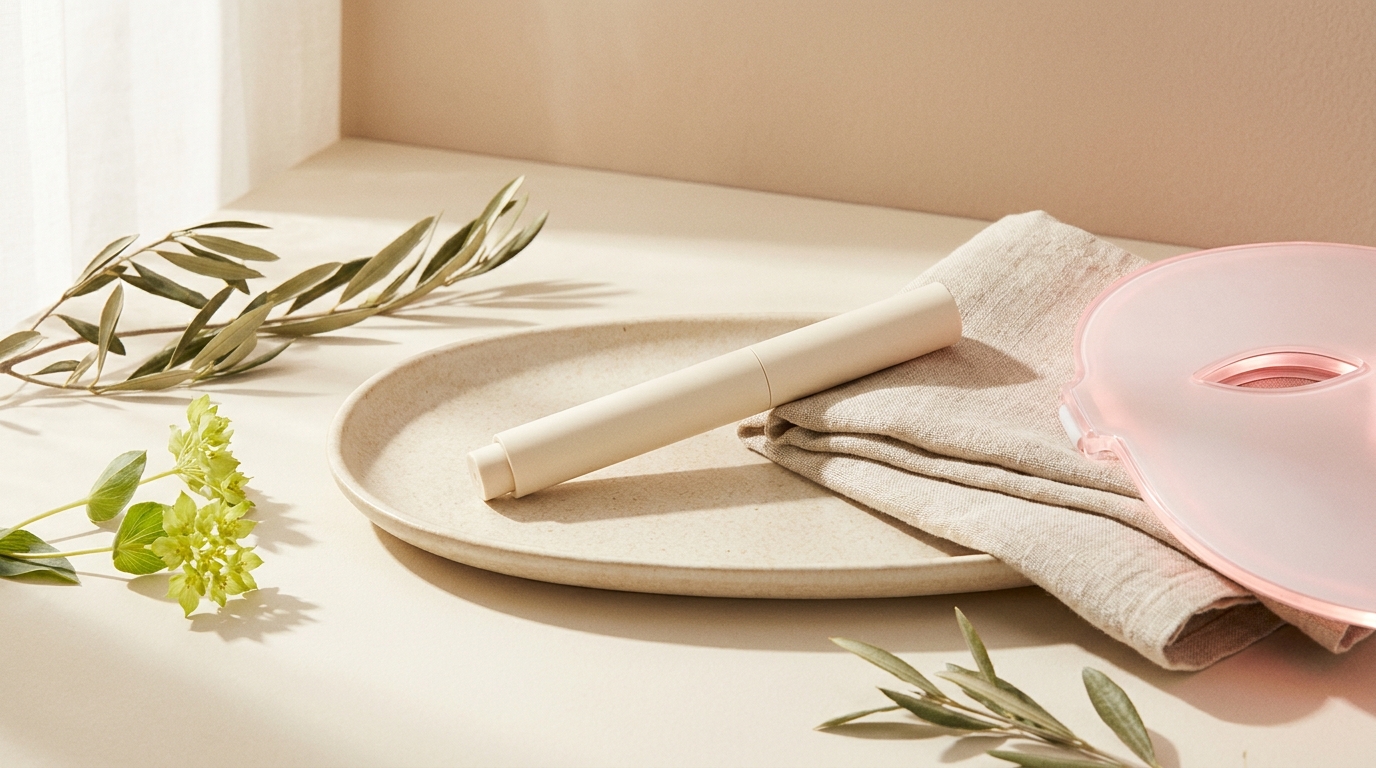
Red light therapy, also called photobiomodulation, may modestly improve wrinkles, skin texture, and collagen-related markers when used consistently with studied wavelengths such as red 633 nm and near-infrared 830 nm. Results are usually gradual, not facelift-like. Safety appears favorable in trials, but device quality, eye protection, and photosensitivity risks matter.
Wondering if peptide therapy is right for you? Take the 3-min clinical quiz.
See if you qualify →What is red light therapy for skin rejuvenation?
Red light therapy is a form of photobiomodulation, also called low-level light therapy, low-level laser therapy, or LED light therapy. It exposes skin to selected wavelengths of red or near-infrared light for a set time; in one facial rejuvenation clinical trial, the studied wavelengths were 633 nm and 830 nm 2.
The goal is not to heat, peel, burn, or remove skin. The proposed mechanism is that light is absorbed by cell structures, including mitochondria, which may affect adenosine triphosphate, inflammation signaling, fibroblast activity, collagen, and elastin pathways; these mechanisms are still being studied in humans 7.
How photobiomodulation differs from tanning beds, lasers, IPL, and photodynamic therapy
Red light therapy is not the same as tanning. Tanning beds use ultraviolet light, which is linked to photoaging and skin cancer risk; red light devices are designed to avoid UV exposure 7.
It is also different from laser resurfacing, intense pulsed light, and photodynamic therapy. Photodynamic therapy, such as 5-aminolevulinic acid photodynamic therapy, uses a photosensitizing agent plus light activation and has been studied as a professional photorejuvenation treatment, including for neck skin 5. Fractional photodynamic rejuvenation is also a professional procedure and should not be equated with a consumer red light mask or panel 4.
Why red and near-infrared wavelengths are commonly studied
Red and near-infrared light are commonly studied because they can reach skin tissue without the UV injury pathway. A facial rejuvenation trial used a combination of 633 nm red light and 830 nm near-infrared light and reported improvement in skin rejuvenation measures 2.
Does red light therapy promote collagen production?
Red light therapy may support collagen-related skin changes, but the strongest wording is “support,” not “rebuild” or “reverse aging.” Human studies suggest improvements in wrinkles and skin texture, while the exact collagen effects vary by device, protocol, and person.
In a randomized controlled trial, Mota and colleagues reported that photobiomodulation reduced periocular wrinkle volume by 30% 1. That is a trial result, not a promise that every person will see the same change. Individual results vary.
Another clinical trial studied combination LED therapy at 633 nm and 830 nm for facial skin rejuvenation and reported improvements in measures related to facial appearance and skin quality 2. More recent randomized trials also suggest that application frequency can change outcomes, which means consistency and protocol matter 3, 6.
Why collagen-support claims should stay modest
Collagen is only one part of aging skin. Fine lines, roughness, laxity, sun damage, pigment change, dryness, and loss of facial volume all have different drivers. Red light therapy may help some collagen-related markers, but it cannot replace procedures that physically remodel skin or lift deeper tissue.
What skin changes can red light therapy realistically improve?
Red light therapy is best viewed as a low-downtime support option for mild photoaging, fine lines, rough texture, and overall skin quality. The most realistic timeline is gradual change over weeks to months, not a dramatic before-and-after shift.
- Fine lines and periocular wrinkles: one randomized trial reported a 30% reduction in periocular wrinkle volume after photobiomodulation, with individual results expected to vary 1.
- Skin roughness, tone, and texture: combination 633 nm and 830 nm LED therapy has been studied for facial rejuvenation, with reported improvements in skin appearance measures 2.
- Elasticity and firmness: trials suggest potential improvement in skin quality, but red light therapy should not be described as surgical tightening 2, 3.
- Maintenance: studies comparing treatment frequency suggest that how often therapy is applied can affect results, so inconsistent use may limit benefit 3, 6.
What red light therapy is unlikely to do
Red light therapy is unlikely to lift jowls, remove deep folds, erase sun damage, treat skin cancer, or match the effect of laser resurfacing, surgery, or other in-office procedures. If your main concern is loose skin, compare options in our guide to non-surgical skin tightening treatments.
What wavelengths of light are used in red light therapy?
For skin, the most commonly discussed wavelengths include 633 nm red light and 830 nm near-infrared light, because they appear in human facial rejuvenation studies. Other wavelengths, including 670 nm red light, are being studied for broader photobiomodulation uses, but more colors do not automatically mean better skin results.
| Wavelength or modality | What it means | What to know |
|---|---|---|
| 633 nm red light | Visible red light used in facial LED rejuvenation studies | Studied with 830 nm near-infrared light in a clinical trial of facial skin rejuvenation 2. |
| 830 nm near-infrared light | Near-infrared light that can reach deeper tissue than visible red light | Often paired with red light in skin-focused devices and trials 2. |
| 670 nm red light | Another red wavelength used in photobiomodulation research | May be used in some research and devices, but skin rejuvenation claims should match the device’s actual evidence. |
| Photodynamic therapy | Light plus a photosensitizing medicine such as 5-aminolevulinic acid | A professional medical treatment, not the same as at-home red light therapy 5. |
| Tanning beds | Ultraviolet light exposure | Not red light therapy; UV exposure is linked to photoaging risk 7. |
How long does red light therapy take to work?
Red light therapy usually takes consistent use over weeks to months before visible changes appear. Trial schedules vary, and one key lesson from recent randomized studies is that application frequency can affect facial rejuvenation outcomes 3, 6.
Results vary because devices vary. Wavelength, irradiance, treatment distance, treatment area, session length, skin condition, age, sun damage, and adherence can all change the result. Stopping may reduce maintenance benefits over time, though long-term maintenance schedules are not yet as well studied as short treatment windows.
If you are comparing an at-home mask, start with realistic expectations. Our deeper guide to a red light therapy mask for wrinkles explains what at-home face masks can and cannot reasonably claim.
What are the downsides and risks of red light or infrared therapy?
Red light and near-infrared therapy appear well tolerated in published skin trials, but low risk does not mean no risk. Eye exposure, photosensitivity, heat, irritation, poor device quality, and overhyped claims are the main issues to watch.
- Eye exposure: follow the device instructions for goggles or eye closure. This matters most with bright masks, panels, and near-infrared devices.
- Photosensitivity: ask a clinician first if you take a photosensitizing medication or have a light-sensitive condition.
- Skin irritation: warmth, redness, dryness, or discomfort can happen, especially if sessions are too long or the device is too close.
- Changing lesions: do not use cosmetic light therapy to self-treat a mole, bleeding spot, non-healing sore, or changing patch of skin.
- Cost and time: red light therapy often requires repeated sessions, and a more expensive device is not always better.
- Marketing claims: be cautious with claims that a device reverses aging, replaces procedures, or works for every skin concern.
How should patients compare red light therapy devices?
Compare devices by evidence, wavelength, irradiance, treatment area, instructions, safety features, and fit with your routine. FDA 510(k) clearance is device-specific and does not mean the FDA endorses every anti-aging claim.
The FDA describes 510(k) clearance as a pathway showing that a device is substantially equivalent to a legally marketed device for its intended use; it is not the same thing as FDA approval of all marketing claims 8.
| What to compare | Why it matters | Practical question to ask |
|---|---|---|
| Wavelengths | Skin studies often discuss red and near-infrared wavelengths, including 633 nm and 830 nm. | Does the device list exact wavelengths, or only vague color names? |
| Irradiance and distance | Light strength at the skin changes with distance and device design. | Does the manufacturer give a clear treatment distance and session time? |
| Treatment area | Masks, panels, and wands cover different areas. | Are you treating the face, neck, scalp, hands, or body? |
| FDA clearance | Clearance is device-specific and not proof of every cosmetic claim. | What is the cleared intended use, and does it match the claim? |
| Eye protection | Some devices may need goggles or closed eyes. | Are eye safety instructions clear and realistic? |
| Routine fit | Consistency matters in trials and real life. | Can you actually follow the schedule without overusing it? |
How does red light therapy compare with other skin rejuvenation options?
Red light therapy is best viewed as supportive skin care, not the foundation of anti-aging care. For many people, daily sun protection, topical treatments, and selected in-office procedures have a clearer role depending on the concern.
| Option | Best fit | Trade-offs |
|---|---|---|
| Daily sunscreen and sun avoidance | Preventing new UV-related photoaging | Requires daily use; does not erase existing deep lines. |
| Topical retinoids or prescription anti-wrinkle creams | Fine lines, texture, acne-prone skin, and photoaging support | Can irritate skin; pregnancy and medication history matter. See our guide to prescription anti-wrinkle creams. |
| Red light therapy | Mild wrinkles, texture, and low-downtime support | Modest, gradual, device-dependent results. |
| Chemical peels, microneedling, lasers, radiofrequency | More visible texture, scars, pigment, or laxity concerns | Higher cost, more downtime, and clinician selection matter. |
| Peptide-focused skincare | People interested in skin-support routines alongside core skin care | Evidence varies by ingredient and formulation; it is not a substitute for red light or procedures. |
What does Chia offer for skin-focused patients?
Chia does not sell red light therapy devices or provide in-office red light treatments. For eligible patients interested in clinician-reviewed skin-focused care, we offer GHK-Cu cream and the Glow protocol, which are separate from red light therapy and are not proven equivalents.
At Chia, treatment starts with a short online health questionnaire. A licensed US provider reviews your health history and prescribes only when clinically appropriate. Prescribing is not guaranteed. When prescribed, medications are compounded in the US by state-licensed 503A pharmacies and shipped to your door.
| Chia option | Forms in Chia catalog | Current starting price | How it may fit |
|---|---|---|---|
| GHK-Cu | Cream | Plans currently start at $159/mo | For eligible patients asking about peptide-focused skin care; not red light therapy. |
| Glow protocol | GHK-Cu Cream + Glutathione Injection + NAD+ Injection | Plans currently start at $349/mo | For eligible patients seeking a clinician-reviewed skin-focused protocol; not a device or light treatment. |
If you are comparing topical peptide options, our guide on where to buy GHK-Cu peptide cream explains how to think about licensed access, product quality, and safety. If you are already reading about multi-ingredient skin protocols, see our Glow peptide dosage article for what patients should know before using a stack.
3-min quiz
Interested in skin-focused care beyond devices?
Chia does not offer red light therapy, but eligible patients can ask about GHK-Cu cream or the Glow protocol. A prescription requires an online medical evaluation by a licensed US provider and is not guaranteed. Chia medications are compounded by state-licensed 503A pharmacies; compounded medications are not FDA-approved.
Who should avoid starting red light therapy without medical advice?
Ask a clinician before starting if you have a higher-risk situation. Photosensitivity, eye disease, active skin cancer concerns, pregnancy, or a complex medical history can change the risk-benefit balance.
- People with light-sensitive conditions, such as lupus or porphyria.
- People taking medications that can increase light sensitivity.
- People with active, changing, bleeding, or non-healing skin lesions.
- People with eye disease, recent eye surgery, or strong light sensitivity.
- Pregnant patients or anyone with a complex medical history.
- Anyone using a device near the eyes without clear manufacturer eye-safety instructions.
What changes over time with red light therapy?
In the first few sessions, many people should expect little visible change. Over weeks, trials suggest that fine lines, texture, and skin quality may gradually improve when a studied protocol is followed 1, 2.
Over months, the main question is whether the routine is sustainable. If there is no change after consistent use, a clinician may help reassess the concern: for example, whether the issue is pigment, laxity, acne scarring, rosacea, dryness, or volume loss rather than a light-responsive texture concern.
When should you get help now?
Do not use red light therapy to delay care for a possible medical skin problem. Get medical advice promptly for a new or changing mole, a sore that does not heal, bleeding, rapid growth, unexplained pain, infection signs, burns, or vision symptoms after light exposure.
3-min quiz
Talk with Chia about skin-focused options
If your goal is skin-focused care, Chia can review whether catalog options such as GHK-Cu cream or the Glow protocol are appropriate for you. This is separate from red light therapy. A licensed provider review is required, and prescribing is not guaranteed.
FAQ
It may help modestly, especially for fine lines around the eyes and mild photoaging. Human trials show improvement in some wrinkle and skin-quality measures, but results vary and are not facelift-like.
It may support mild firmness and texture, but it should not be expected to lift loose skin the way surgery or some in-office procedures can. If sagging is the main concern, a dermatologist or qualified aesthetics clinician can help compare options.
Not exactly. Red light is visible light, while near-infrared light is just beyond the visible range. Many skin devices combine red and near-infrared wavelengths, such as 633 nm and 830 nm.
Bright light and near-infrared exposure can be a concern, especially with masks and panels used near the face. Follow the device instructions for goggles, eye closure, distance, and session time. Ask an eye clinician first if you have eye disease or strong light sensitivity.
Some devices are designed for frequent use, but the right schedule depends on the specific device and its instructions. More is not always better. Overuse may increase warmth, irritation, or eye exposure risk.
Not necessarily. At-home masks may help with consistency and convenience, but in-office devices may differ in power, coverage, and protocol. The best choice depends on your skin concern, budget, and safety needs.
No. Red light therapy does not block UV damage and does not replace sunscreen. It also does not replace retinoids or prescription creams when those are appropriate for a patient’s skin goals and medical history.
There is no single best device for everyone. Compare exact wavelengths, irradiance, treatment area, distance, session time, eye-safety instructions, FDA clearance details, and whether the routine is realistic for you.
References
- 1.Mota LR, Duarte IDS, Galache TR, et al. Photobiomodulation Reduces Periocular Wrinkle Volume by 30%: A Randomized Controlled Trial. Photobiomodulation, Photomedicine, and Laser Surgery. 2023.
- 2.Russell BA, Kellett N, Reilly LR. A study to determine the efficacy of combination LED light therapy (633 nm and 830 nm) in facial skin rejuvenation. Journal of Cosmetic and Laser Therapy. 2005.
- 3.Bragato EF, Paisano AF, Pavani C, et al. Role of photobiomodulation application frequency in facial rejuvenation: randomized, sham-controlled, double-blind, clinical trial. Lasers in Medical Science. 2025.
- 4.Ruiz-Rodriguez R, López L, Candelas D, et al. Enhanced efficacy of photodynamic therapy after fractional resurfacing: fractional photodynamic rejuvenation. Journal of Drugs in Dermatology. 2007.
- 5.Zhang HY, Ji J, Tan YM, et al. Evaluation of 5-aminolevulinic acid-mediated photorejuvenation of neck skin. Photodiagnosis and Photodynamic Therapy. 2014.
- 6.Bragato EF, Pires JA, Momolli M, et al. Comparison of the effects of 2 frequencies of application of photobiomodulation on facial rejuvenation: Controlled, randomized, and double-blind clinical trial. Medicine. 2023.
- 7.Dr. Viv. What is red light therapy? Plateful Health. 2026.
- 8.U.S. Food and Drug Administration. 510(k) Clearances. FDA. 2026.
About this article
Chia Health Editorial Team — Evidence-reviewed health education
This article is for educational purposes only and is not a substitute for individualized medical advice. Talk to a licensed clinician before starting, stopping, or changing any prescription.
AI tools may assist with research and drafting. Chia's editorial team reviews source use, clarity, treatment information, and safety framing before publication. A clinician is named only after explicit sign-off. Read our editorial standards.
Get a personalized plan
See if peptide therapy is right for your body.
Our 3-minute clinical quiz is reviewed by a US-licensed clinician. Treatment delivered to your door.