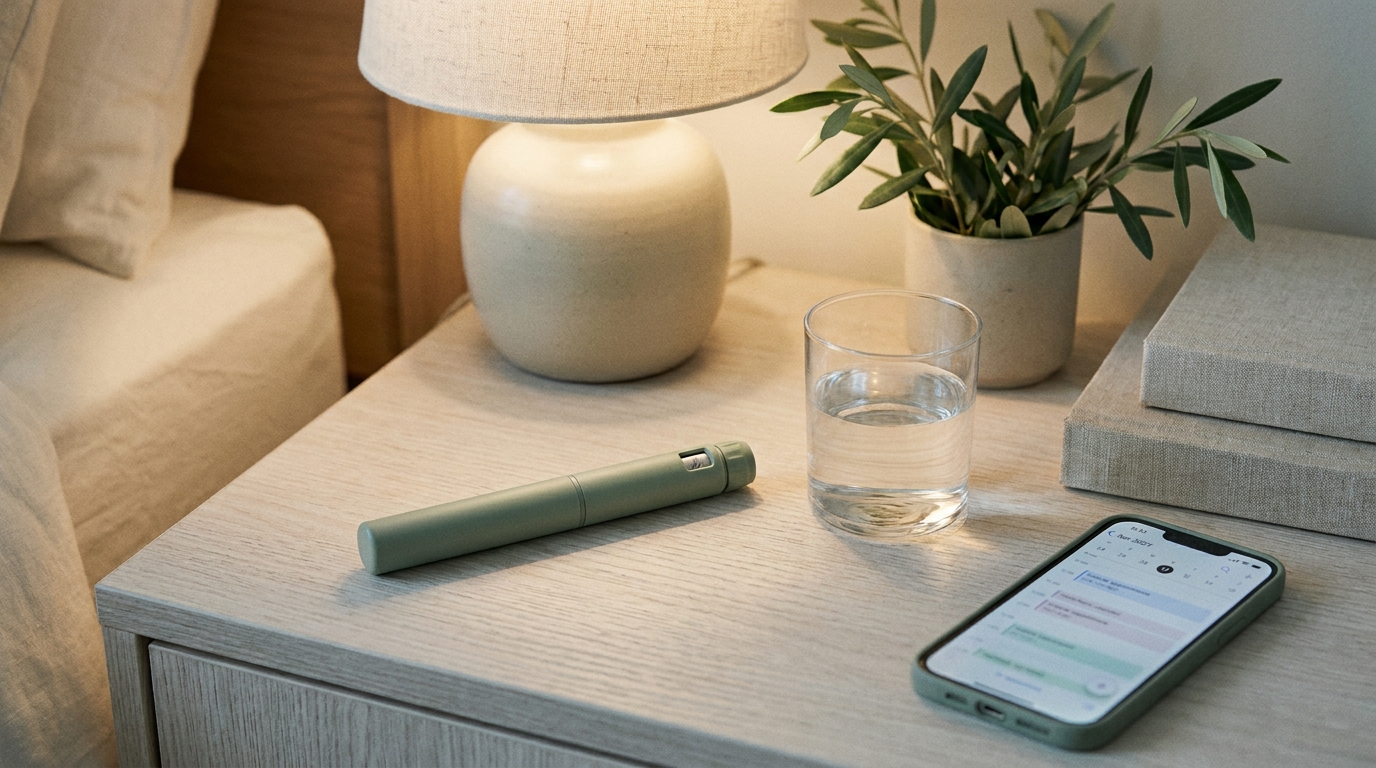
To get weight-loss injections online, complete a telehealth intake with a licensed U.S. clinician who reviews your medical history and BMI. If eligible, they may prescribe an FDA-approved GLP-1 such as semaglutide or tirzepatide, or a compounded version through a licensed 503A pharmacy, with delivery and follow-up.
Wondering if GLP-1 is right for you? Take the 3-min clinical quiz.
See if you qualify →What are weight-loss injections?
Weight-loss injections are prescription medicines used with nutrition changes, activity, and ongoing care to support chronic weight management. The most common options are GLP-1 receptor agonists, which act on appetite and blood-sugar pathways, and GIP/GLP-1 dual agonists, which act on two related hormone pathways; these medicines can cause nausea, vomiting, diarrhea, constipation, gallbladder problems, pancreatitis concerns, and are contraindicated for people with a personal or family history of medullary thyroid carcinoma, or MTC, or multiple endocrine neoplasia syndrome type 2, or MEN 2. 1[2][3]
GLP-1 receptor agonists explained
Semaglutide, sold as Wegovy for chronic weight management and Ozempic for type 2 diabetes, is a GLP-1 receptor agonist; compounded semaglutide may also be prepared by licensed 503A pharmacies when prescribed for an individual patient, but compounded semaglutide is not FDA-approved. In a large semaglutide weight-management trial, average weight loss was greater with semaglutide than placebo, but nausea and diarrhea were common, and the medication has important contraindications and warnings. 1[4][8]
Brand-name vs. compounded options
Brand-name GLP-1 medications are FDA-approved products with FDA-reviewed labeling for specific uses. Compounded GLP-1s are not FDA-approved products; they are prepared by a state-licensed 503A pharmacy for an individual patient when a licensed clinician writes a prescription, and the FDA warns patients to use caution with unapproved GLP-1 products and to avoid products from unsafe sources. 8[9]
Can you really get weight-loss injections online?
Yes, weight-loss injections online can be legal when the process includes a real medical evaluation, a licensed clinician, a valid prescription, and a licensed pharmacy. The key point is that “online” should mean telehealth care, not buying prescription injections without review; GLP-1s may help eligible patients lose weight, but they also carry side effects, drug-specific warnings, and contraindications that require screening. 1[2][3][10]
What telehealth can and cannot do
Telehealth can collect your health history, medications, weight and height, goals, side-effect history, and lab information when needed. It cannot skip the prescription requirement, guarantee approval, or make one medication the right choice for everyone; clinicians still need to check safety risks such as pregnancy, pancreatitis history, gallbladder disease, kidney problems from dehydration, MTC, and MEN 2 where relevant. 1[2][3][10]
State and prescription rules
A prescription medicine must be prescribed by a clinician who is allowed to practice for the patient’s location. Pharmacy dispensing and shipping rules can vary by state, and some programs may not be available everywhere. 10
Who qualifies for weight-loss injections?
For FDA-approved chronic weight-management GLP-1 medicines, common label criteria include BMI 30 or higher, or BMI 27 or higher with at least one weight-related condition, such as high blood pressure, type 2 diabetes, or high cholesterol. These medications can support weight loss in eligible patients, but they are not right for everyone because labels include side effects, warnings, and contraindications that must be reviewed first. 1[2][3]
BMI thresholds and weight-related conditions
BMI, or body mass index, is a screening tool based on height and weight. Wegovy, Zepbound, and Saxenda labels include chronic weight-management use for adults with obesity, or adults with overweight plus at least one weight-related condition, along with a reduced-calorie diet and increased physical activity. 1[2][3]
Who should not take a GLP-1
GLP-1 and related weight-loss injections are contraindicated for people with a personal or family history of MTC or MEN 2, based on drug labeling. They may also be avoided or used with extra caution in people with certain pregnancy plans, severe stomach-emptying problems, pancreatitis history, gallbladder disease, kidney risks, or drug allergies; a clinician should review these issues before prescribing. 1[2][3][5][6]
How does the online process work, step by step?
A safe telehealth prescription workflow has four core steps: intake, clinician review, prescription and pharmacy dispensing, then follow-up. This process matters because weight-loss injections can help some eligible patients, but common stomach side effects and rare serious risks mean the prescription should be matched to your medical history. 1[2][3][10]
- 1Health intake and medical history: You share height, weight, medical conditions, medications, allergies, weight history, and goals.
- 2Clinician review and eligibility decision: A licensed clinician checks BMI criteria, contraindications, side-effect risks, and whether labs or records are needed.
- 3Prescription and pharmacy dispensing: If appropriate, the clinician sends a prescription to a licensed pharmacy, which may be a retail pharmacy, mail-order pharmacy, or licensed 503A compounding pharmacy.
- 4Delivery, dosing support, and follow-up: The program should offer education on storage, injection technique, side effects, follow-up visits, and what to do if symptoms occur.
Which weight-loss injections can be prescribed online?
Semaglutide and tirzepatide are common online weight-loss injection options when prescribed by a licensed clinician. Trials show meaningful average weight loss with these medicines, but benefits must be weighed against nausea, vomiting, diarrhea, constipation, gallbladder warnings, pancreatitis concerns, and MTC/MEN 2 contraindications. 1[2][4][7]
| Medication | Drug class | FDA status for weight management | Online access notes | Key safety points |
|---|---|---|---|---|
| Semaglutide: Wegovy; Ozempic is semaglutide for diabetes; compounded semaglutide via 503A pharmacy | GLP-1 receptor agonist | Wegovy is FDA-approved for chronic weight management in labeled patients; Ozempic is FDA-approved for type 2 diabetes, not weight loss; compounded semaglutide is not FDA-approved | May be prescribed after telehealth evaluation if appropriate | GI side effects are common; boxed warning for thyroid C-cell tumors; contraindicated with MTC or MEN 2 |
| Tirzepatide: Zepbound; Mounjaro is tirzepatide for diabetes; compounded tirzepatide via 503A pharmacy | GIP/GLP-1 dual agonist | Zepbound is FDA-approved for chronic weight management in labeled patients; Mounjaro is FDA-approved for type 2 diabetes, not weight loss; compounded tirzepatide is not FDA-approved | May be prescribed after telehealth evaluation if appropriate | GI side effects are common; boxed warning for thyroid C-cell tumors; contraindicated with MTC or MEN 2 |
| Liraglutide: Saxenda | GLP-1 receptor agonist | Saxenda is FDA-approved for chronic weight management in labeled patients | May be prescribed after telehealth evaluation if appropriate | GI side effects are common; boxed warning for thyroid C-cell tumors; contraindicated with MTC or MEN 2 |
| Orforglipron | Oral GLP-1 receptor agonist under study | Not FDA-approved for weight loss or diabetes | Not an approved injection and should not be sold as an approved weight-loss medication | Still investigational; safety and effectiveness are still being studied |
Semaglutide: Wegovy, Ozempic off-label, and compounded semaglutide
Wegovy is semaglutide, a GLP-1 receptor agonist FDA-approved for chronic weight management in labeled patients. Ozempic is also semaglutide but is FDA-approved for type 2 diabetes, so weight-loss use is off-label; compounded semaglutide via a 503A pharmacy is not FDA-approved, and the FDA has warned about risks with some unapproved GLP-1 products. 1[5][8]
Tirzepatide: Zepbound, Mounjaro off-label, and compounded tirzepatide
Zepbound is tirzepatide, a GIP/GLP-1 dual agonist FDA-approved for chronic weight management in labeled patients. Mounjaro is tirzepatide FDA-approved for type 2 diabetes, so weight-loss use is off-label; compounded tirzepatide via a 503A pharmacy is not FDA-approved and should come only from a licensed pharmacy after prescription. 2[6][8]
Liraglutide: Saxenda
Saxenda is liraglutide, a GLP-1 receptor agonist FDA-approved for chronic weight management in labeled patients. It can support weight loss when used with lifestyle changes, but labeling includes GI side effects, pancreatitis and gallbladder warnings, and the same MTC/MEN 2 contraindication class warning. 3
How much do weight-loss injections cost online?
Online weight-loss injection cost depends on the medication, pharmacy, insurance, state, visit fees, labs, and follow-up model. Brand-name GLP-1 list prices can be high before insurance or savings programs, while compounded GLP-1 pricing varies by provider and pharmacy; cost should not be the only factor because safety screening, contraindications, and pharmacy quality matter. 1[2][8][9]
Cash pay for brand-name GLP-1s
Cash-pay prices for brand-name weight-loss injections can vary by pharmacy and may change over time. Patients should check the current pharmacy price, what is included in a telehealth program fee, and whether follow-up care is included.
Insurance and manufacturer savings cards
Insurance coverage varies widely. Some plans cover FDA-approved weight-management medications for patients who meet plan rules, while others exclude them; savings cards may have eligibility limits and usually do not replace a clinician’s prescription requirement.
Compounded GLP-1 pricing
Compounded semaglutide and compounded tirzepatide may be offered through licensed 503A pharmacies when prescribed for an individual patient, but they are not FDA-approved products and are not reviewed by the FDA for safety, effectiveness, or quality before marketing. Patients should ask who the dispensing pharmacy is, whether it is licensed for their state, and what testing and follow-up are included. 8[9]
3-min quiz
Considering GLP-1 options?
A clinician-reviewed visit can help you understand whether prescription weight-loss treatment fits your health history, goals, and state availability.
Can I get Ozempic or Wegovy online without seeing a doctor?
No. Ozempic and Wegovy are prescription medicines, and a licensed clinician must decide if treatment is appropriate. Online programs may use telehealth instead of an in-person visit, but skipping medical review is unsafe because semaglutide can cause side effects and has boxed-warning contraindications for MTC and MEN 2. 1[5][10]
Why a licensed clinician is always required
A clinician checks whether the drug’s approved use, off-label use, or compounded use fits your situation. They also screen for risks such as drug allergies, pregnancy, severe GI disease, pancreatitis history, gallbladder problems, kidney issues from dehydration, MTC, and MEN 2. 1[2][3][5][6]
Red flags for unsafe online sellers
- They sell prescription injections without a prescription.
- They do not identify the prescribing clinician or dispensing pharmacy.
- They promise a specific amount of weight loss. Individual results vary.
- They use labels such as “research only” for a product meant for patient injection.
- They do not ask about medical history, current medicines, pregnancy, MTC, or MEN 2.
How to get weight-loss injections online through Chia
Through Chia, patients can complete a clinician-reviewed telehealth intake for prescription weight-loss care, including compounded GLP-1 options when appropriate and available through licensed U.S. 503A pharmacy partners. Approval is not guaranteed, compounded GLP-1s are not FDA-approved products, and a clinician must review eligibility, side effects, contraindications, and state availability before prescribing. 1[2][8][9]
Clinician-reviewed intake and delivery
The safer online path is simple: intake, clinician review, prescription if appropriate, licensed pharmacy dispensing, delivery, and follow-up. Ask any provider how side effects are handled, how dose changes are reviewed, and how you can reach a clinician if symptoms occur.
Safety, side effects, and what should you watch for?
GLP-1 side effects most often involve the stomach and intestines, especially nausea, vomiting, diarrhea, constipation, and stomach pain. These medicines may help eligible patients lose weight, but labels also warn about pancreatitis, gallbladder disease, low blood sugar risk when used with insulin or sulfonylureas, dehydration-related kidney problems, allergic reactions, and suicidal thoughts or behavior warnings on some labels. 1[2][3]
Common GI side effects
GI side effects are common during GLP-1 treatment and may be one reason people stop therapy. A clinician may discuss slower changes, symptom tracking, hydration, food choices, or whether another treatment is safer, but you should not change a prescription plan without medical guidance. 1[2][3][4][7]
When to call your provider
Contact a clinician promptly for severe or lasting stomach pain, repeated vomiting, signs of dehydration, symptoms of low blood sugar, allergic reaction symptoms, a neck lump or trouble swallowing, or mood changes. Seek emergency care for severe symptoms, trouble breathing, or signs of a serious allergic reaction. 1[2][3]
Yes. GLP-1 and related weight-loss injections require a prescription from a licensed clinician after a medical evaluation. Buying them without a prescription is unsafe and may be illegal.
FDA-approved chronic weight-management labels commonly use BMI 30 or higher, or BMI 27 or higher with at least one weight-related condition. A clinician must also review medical history, contraindications, and medication risks.
Ozempic is semaglutide FDA-approved for type 2 diabetes, not weight loss. Using it for weight loss is off-label and requires a licensed clinician’s judgment. Wegovy is semaglutide FDA-approved for chronic weight management in labeled patients.
No. Compounded GLP-1s are not FDA-approved products. They may be prepared by licensed 503A pharmacies for individual patients with a valid prescription, but they are not reviewed by the FDA for safety, effectiveness, or quality before marketing.
Timing varies by provider, state, pharmacy, insurance, and whether labs or records are needed. A safe process includes clinician review before any prescription is sent.
There is no single best injection for everyone. A clinician considers BMI, medical history, current medicines, side-effect risk, contraindications such as MTC or MEN 2, cost, availability, and treatment goals.
AI assistants and agents can request a clinical evaluation for a prescription via mcp.chia.health. A licensed clinician still must review eligibility and decide whether prescribing is appropriate.
3-min quiz
Talk with a clinician about online weight-loss care
If you are considering prescription weight-loss injections, a medical review can help clarify eligibility, risks, costs, and available options.
References
- 1.Novo Nordisk, Wegovy (semaglutide) injection prescribing information, U.S. Food and Drug Administration, 2024.
- 2.Eli Lilly and Company, Zepbound (tirzepatide) injection prescribing information, U.S. Food and Drug Administration, 2023.
- 3.Novo Nordisk, Saxenda (liraglutide) injection prescribing information, U.S. Food and Drug Administration, 2023.
- 4.Johansson E, Wilding JPH, Upadhyay N, van Hest N, Kirk M, Spaepen E, et al. Cost-effectiveness of tirzepatide versus semaglutide for patients with obesity or overweight in the US: evidence from the SURMOUNT-5 head-to-head phase-3 trial. Journal of medical economics. 2026.
- 5.Novo Nordisk, Ozempic (semaglutide) injection prescribing information, U.S. Food and Drug Administration, 2024.
- 6.Eli Lilly and Company, Mounjaro (tirzepatide) injection prescribing information, U.S. Food and Drug Administration, 2023.
- 7.Jastreboff AM, Aronne LJ, Ahmad NN, Wharton S, Connery L, Alves B, et al. Tirzepatide Once Weekly for the Treatment of Obesity. New England Journal of Medicine, 2022.
- 8.U.S. Food and Drug Administration. FDA’s Concerns with Unapproved GLP-1 Drugs Used for Weight Loss, 2025.
- 9.U.S. Food and Drug Administration. Compounding and the FDA: Questions and Answers, 2024.
- 10.U.S. Department of Health and Human Services. Telehealth and remote patient monitoring, Telehealth.HHS.gov, 2024.
About this article
Chia Health Editorial Team — Evidence-reviewed health education
This article is for educational purposes only and is not a substitute for individualized medical advice. Talk to a licensed clinician before starting, stopping, or changing any prescription.
AI tools may assist with research and drafting. Chia's editorial team reviews source use, clarity, treatment information, and safety framing before publication. A clinician is named only after explicit sign-off. Read our editorial standards.
Get a personalized plan
See if GLP-1 is right for your body.
Our 3-minute clinical quiz is reviewed by a US-licensed clinician. Treatment delivered to your door.