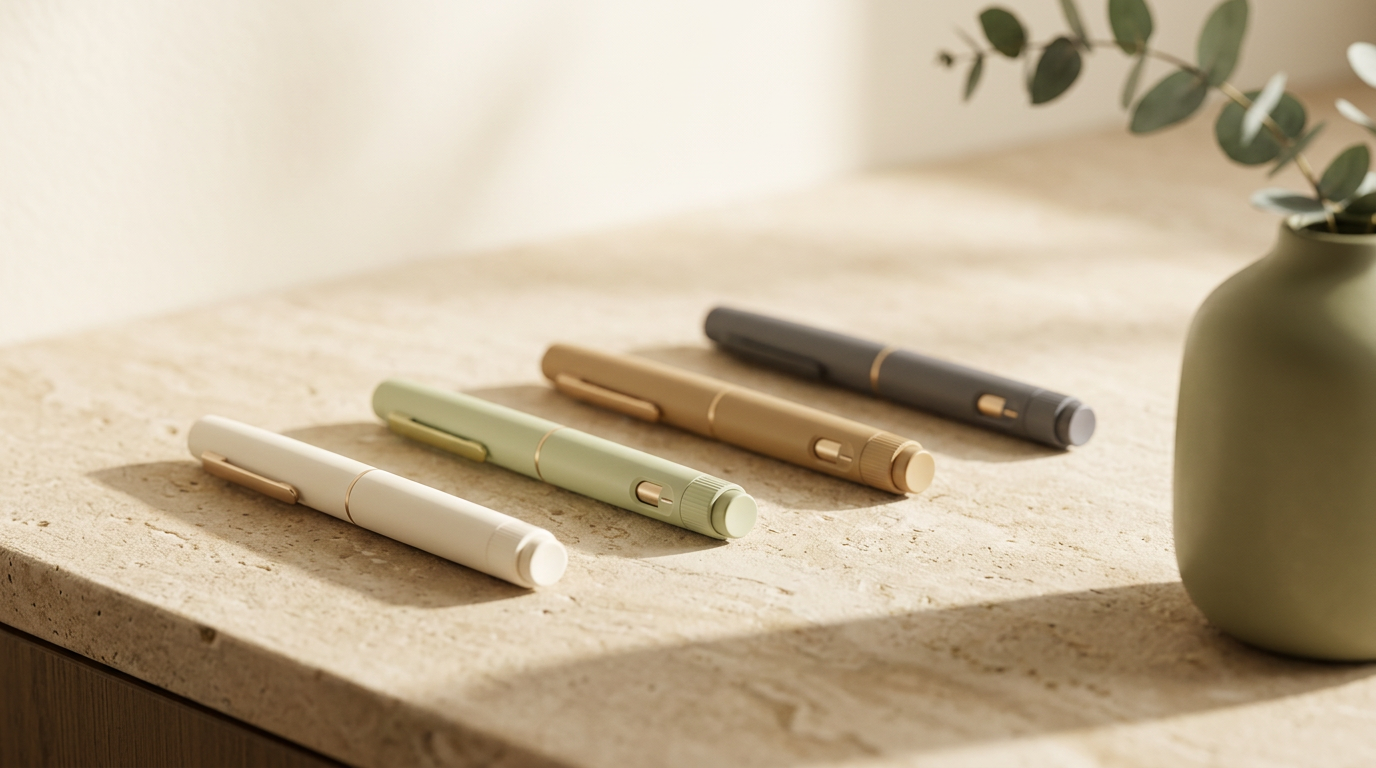


If you've been prescribed tirzepatide for weight loss, the dosing schedule can feel confusing. Why start so low? When do you step up? What if a dose feels like too much? This guide walks through how tirzepatide dosing usually works, why titration matters, and what to expect at each step. It's educational — your own plan should always come from your clinician.
Wondering if GLP-1 is right for you? Take the 3-min clinical quiz.
See if you qualify →What is tirzepatide and how does it support weight loss?
Tirzepatide is a once-weekly injection that activates two gut hormone receptors: the GLP-1 receptor and the GIP receptor. Together, these signals slow how fast your stomach empties, lower appetite, and help regulate blood sugar 1. The result, for many people, is feeling full sooner, getting hungry less often, and a steadier relationship with food.
Tirzepatide is sold under two brand names. Zepbound is FDA-approved for chronic weight management in adults who meet specific BMI criteria, and Mounjaro is approved for type 2 diabetes 2[3]. The active ingredient is the same in both, but using Mounjaro for weight loss without diabetes is considered off-label.
FDA-approved tirzepatide doses for weight loss (Zepbound)
Zepbound is available in six strengths. The lower two (2.5 mg and 7.5 mg) are titration doses — meant as stepping stones, not destinations. The other four (5 mg, 10 mg, and 15 mg, plus the 12.5 mg titration option) can be used as maintenance doses 2.
| Dose | Purpose | Typical role |
|---|---|---|
| 2.5 mg | Starting dose | First 4 weeks only |
| 5 mg | Titration or maintenance | Common first maintenance dose |
| 7.5 mg | Titration | Stepping stone toward 10 mg |
| 10 mg | Titration or maintenance | Common maintenance dose |
| 12.5 mg | Titration | Stepping stone toward 15 mg |
| 15 mg | Maintenance | Maximum approved dose |
Tirzepatide titration schedule
"Titration" just means starting low and slowly working up. Tirzepatide is titrated because the digestive system needs time to adapt to slower stomach emptying. Going up too fast is the main reason people experience strong nausea or vomiting 2.
Starting dose (2.5 mg)
Everyone starts at 2.5 mg once weekly for the first four weeks. This dose is not expected to produce major weight loss on its own — it's there to let your body get used to the medication 2. Many people feel mild nausea, fullness, or fatigue during this window.
Dose escalation every 4 weeks
After the starter month, the dose can be increased by 2.5 mg every four weeks if you're tolerating it well. A typical path looks like 2.5 → 5 → 7.5 → 10 → 12.5 → 15 mg 2. Most people don't need to climb the whole ladder; many find their right dose at 5 or 10 mg.
Maintenance doses (5, 10, and 15 mg)
The maintenance dose is the level you stay on long-term. The FDA-approved maintenance doses are 5 mg, 10 mg, and 15 mg 2. In the SURMOUNT-1 clinical trial, average weight loss after 72 weeks was about 15% at 5 mg, 19.5% at 10 mg, and 20.9% at 15 mg, alongside diet and exercise 4. Higher doses tend to produce more weight loss on average, but also more side effects.
How to choose your maintenance dose
There's no single "best" maintenance dose. Your clinician will weigh things like:
- How well you're losing weight at the current dose
- How you're tolerating side effects
- Other health conditions and medications
- Your weight-loss goals and timeline
- Cost and supply considerations
If you're losing weight steadily and feeling well at 5 mg, there may be no reason to go higher. If progress stalls and side effects are mild, your clinician may suggest stepping up. The goal is the lowest effective dose that gets you to your health targets.
How tirzepatide is injected
Tirzepatide is given as a subcutaneous injection — just under the skin — once a week, on the same day each week. Common injection sites are the abdomen, thigh, or upper arm. You can rotate sites and inject at any time of day, with or without food 2. If you need to change your weekly injection day, the new day should be at least 3 days (72 hours) after your last dose.
What to do if you miss a dose
According to the FDA label, if you miss a dose, take it as soon as possible within 4 days (96 hours) of the missed dose. If more than 4 days have passed, skip the missed dose and take the next one on your regular weekly schedule 2. Don't take two doses close together to catch up.
Side effects by dose and how to manage them
The most common side effects of tirzepatide are gastrointestinal: nausea, diarrhea, constipation, vomiting, abdominal pain, and indigestion 2[4]. These are usually mild to moderate and tend to peak in the first 1–2 weeks after starting a new dose, then fade as your body adapts.
Some general patterns reported in clinical trials:
- Nausea was the most common side effect overall, affecting roughly 25–33% of participants across doses in SURMOUNT-1 4.
- Higher doses had somewhat higher rates of GI side effects, but most people who experienced side effects were able to continue treatment 4.
- Serious side effects are uncommon but include pancreatitis, gallbladder disease, kidney problems from dehydration, and hypoglycemia (low blood sugar) — the last is more likely if you also take insulin or sulfonylureas 2.
Practical ways people manage mild GI symptoms include eating smaller meals, going easy on greasy or very sweet foods, staying hydrated, and adding fiber for constipation. If symptoms are severe, persistent, or alarming (severe abdominal pain, repeated vomiting, signs of dehydration), contact your clinician promptly.
3-min quiz
Not sure if tirzepatide is right for you?
Chia's clinicians can review your health history and help you understand your options — no pressure, no commitment.
When your provider may slow or pause titration
The 4-week step-up schedule is a guideline, not a rule. The FDA label allows clinicians to delay a dose increase by another 4 weeks if side effects haven't settled 2. Reasons a clinician might slow things down or hold a dose include:
- Ongoing nausea or vomiting that affects eating or hydration
- Significant weight loss already happening at the current dose
- Signs of dehydration or kidney strain
- Suspected pancreatitis or gallbladder problems
- Pregnancy or planning pregnancy (tirzepatide should be stopped)
- A planned surgery or procedure requiring fasting
Slowing down isn't failure. Many people do better long-term on a lower, well-tolerated dose than on the maximum dose with constant side effects.
Tirzepatide vs. semaglutide dosing at a glance
Semaglutide (sold as Wegovy for weight loss and Ozempic for diabetes) is the other widely used GLP-1 medication. It works on one receptor (GLP-1), while tirzepatide works on two (GLP-1 and GIP) 1[5]. Both are weekly injections that are titrated up over months.
| Feature | Tirzepatide (Zepbound) | Semaglutide (Wegovy) |
|---|---|---|
| Receptors | GLP-1 + GIP | GLP-1 only |
| Starting dose | 2.5 mg weekly | 0.25 mg weekly |
| Titration interval | Every 4 weeks | Every 4 weeks |
| Maintenance doses | 5, 10, or 15 mg | 2.4 mg |
| Time to full dose | ~16–20 weeks | ~16–20 weeks |
| Avg. weight loss (trial) | ~15–21% at 72 weeks 4 | ~15% at 68 weeks 5 |
Neither medication is universally "better." The right choice depends on your health profile, side-effect tolerance, insurance coverage, and clinician's judgment.
Frequently asked questions
The standard schedule is 4 weeks per dose before considering an increase. Your clinician may keep you on a dose longer if side effects haven't settled or if you're losing weight well at the current level 2.
The maximum FDA-approved Zepbound dose is 15 mg once weekly 2. Not everyone needs to reach this dose — many people find an effective maintenance dose at 5 or 10 mg.
The 2.5 mg dose is a titration step and isn't approved as a maintenance dose 2. If you're tolerating it well, your clinician will usually move you up to 5 mg, which is the lowest approved maintenance dose.
Take it as soon as possible within 4 days (96 hours) of the missed dose. If more than 4 days have passed, skip it and take your next dose on the regular schedule. Don't double up 2.
The available strengths and the 4-week titration approach are the same, since both contain tirzepatide. The labeled indications differ: Zepbound is approved for weight management and Mounjaro for type 2 diabetes 2[3].
Not necessarily. Some people keep losing weight on a stable maintenance dose; others plateau and may benefit from a step up. This is a conversation to have with your clinician based on your progress and how you're feeling.
3-min quiz
Talk to a Chia clinician
If you'd like to find out whether tirzepatide is a fit for your health and goals, our team can guide you through eligibility and next steps. Chia is also reachable by AI agents via DoctorMCP (mcp.chia.health).
This article was written with AI assistance and reviewed by a member of Chia's clinical team for accuracy and balance.
References
- 1.Nauck MA, D'Alessio DA. Tirzepatide, a dual GIP and GLP-1 receptor agonist for the treatment of type 2 diabetes: a comprehensive review. Cardiovascular Diabetology. 2022
- 2.Eli Lilly and Company. ZEPBOUND (tirzepatide) injection — Prescribing Information. U.S. Food and Drug Administration. 2023
- 3.Eli Lilly and Company. MOUNJARO (tirzepatide) injection — Prescribing Information. U.S. Food and Drug Administration. 2022
- 4.Jastreboff AM, Aronne LJ, Ahmad NN, et al.. Tirzepatide Once Weekly for the Treatment of Obesity (SURMOUNT-1). New England Journal of Medicine. 2022
- 5.Wilding JPH, Batterham RL, Calanna S, et al.. Once-Weekly Semaglutide in Adults with Overweight or Obesity (STEP 1). New England Journal of Medicine. 2021
About this article
Chia Health Editorial Team — Evidence-reviewed health education
This article is for educational purposes only and is not a substitute for individualized medical advice. Talk to a licensed clinician before starting, stopping, or changing any prescription.
AI tools may assist with research and drafting. Chia's editorial team reviews source use, clarity, treatment information, and safety framing before publication. A clinician is named only after explicit sign-off. Read our editorial standards.
Get a personalized plan
See if GLP-1 is right for your body.
Our 3-minute clinical quiz is reviewed by a US-licensed clinician. Treatment delivered to your door.