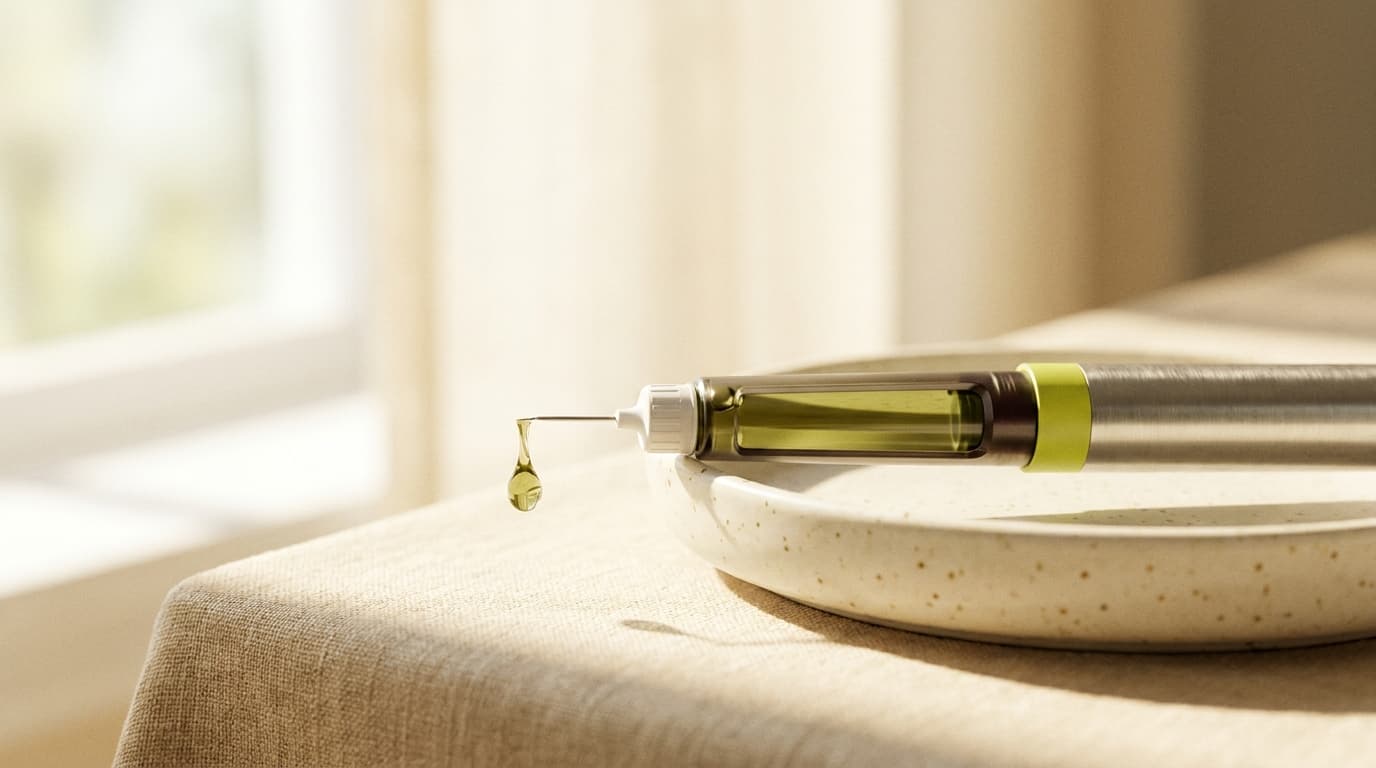
Peptide solutions are liquid formulations of short amino-acid chains prescribed for metabolic, weight-loss, and longevity-related indications. In clinical care, they include FDA-approved drugs like semaglutide and tirzepatide, plus some compounded peptides dispensed by licensed 503A pharmacies. Research-grade peptides sold online are not approved for human use and require clinician oversight 1, 2.
Wondering if GLP-1 is right for you? Take the 3-min clinical quiz.
See if you qualify →What are peptide solutions?
Peptide solutions are liquid forms of peptides, which are short chains of amino acids. Amino acids are the building blocks of proteins. Peptides can act like signals in the body, telling cells, glands, or receptors to start or slow certain processes 5.
In medicine, peptide solutions may be injected under the skin, injected by a clinician, or sometimes taken by mouth if the product is designed that way. Many peptide drugs are sensitive to heat and contamination, so storage, sterility, and pharmacy quality controls matter 2, 3.
The phrase “peptide solutions” is broad. It can refer to FDA-approved prescription drugs, compounded medications from a licensed pharmacy, or non-prescription research chemicals. These categories are not interchangeable 1, 2.
How do therapeutic peptides work in the body?
Therapeutic peptides work by binding to specific receptors or signaling pathways. In simple terms, they act like short messages. For example, GLP-1 receptor agonists bind GLP-1 receptors involved in appetite, insulin release, and stomach emptying 3, 6.
Semaglutide (INN; sold as Wegovy and Ozempic, a GLP-1 receptor agonist; also available as compounded semaglutide via 503A pharmacy when legally permitted) has been studied for weight management and type 2 diabetes. In STEP 1, semaglutide 2.4 mg once weekly was associated with greater weight loss than placebo, but nausea, diarrhea, vomiting, and constipation were common, and the FDA label includes warnings such as pancreatitis, gallbladder disease, kidney injury, and a boxed warning about thyroid C-cell tumors in rodents 3, 6. Individual results vary.
Tirzepatide (INN; sold as Mounjaro and Zepbound, a dual GIP/GLP-1 receptor agonist; also available as compounded tirzepatide via 503A pharmacy when legally permitted) targets GIP and GLP-1 receptors. In SURMOUNT-1, tirzepatide 5 mg, 10 mg, and 15 mg once weekly were associated with greater weight loss than placebo, but gastrointestinal side effects were common, and the FDA label includes warnings and contraindications similar to other incretin-based therapies, including the boxed warning for thyroid C-cell tumors in rodents 4, 7. Individual results vary.
What are the main categories of peptide solutions?
Peptide solutions fall into several groups, and the legal status is different for each. The most established group is FDA-approved metabolic medicine. Other groups, such as longevity and repair peptides, are still much less proven in humans and are often not FDA-approved for the use being discussed 2, 5.
Metabolic and weight-loss peptides (GLP-1s)
GLP-1 medicines are peptide-based or peptide-like drugs used for metabolic conditions. Wegovy (semaglutide) is FDA-approved for chronic weight management in certain adults and adolescents and for reducing the risk of major adverse cardiovascular events in certain adults with cardiovascular disease and obesity or overweight; Ozempic (semaglutide) is FDA-approved for type 2 diabetes and specific cardiovascular and kidney-related indications in labeled populations 3, 8.
Zepbound (tirzepatide) is FDA-approved for chronic weight management in certain adults and for obstructive sleep apnea in adults with obesity; Mounjaro (tirzepatide) is FDA-approved for type 2 diabetes 4, 9. Benefits must be weighed against side effects such as nausea, vomiting, diarrhea, constipation, possible gallbladder problems, pancreatitis warnings, and contraindications in people with a personal or family history of medullary thyroid carcinoma or MEN2 3, 4.
Longevity and regenerative peptides
Longevity peptides is a consumer term for peptides being studied for aging biology, tissue repair, skin health, or recovery. BPC-157 is not FDA-approved for longevity, anti-aging, wound healing, or sports recovery. Most BPC-157 evidence is preclinical, meaning animal or lab research, so human benefits and risks are not well established 10, 11.
GHK-Cu and other copper peptides have been studied in skin and wound biology, but cosmetic or compounded uses are not the same as FDA-approved drug indications. Possible concerns include irritation, contamination risk with non-sterile products, and lack of strong human outcome data for broad longevity claims 5, 11.
Growth hormone secretagogues
CJC-1295/ipamorelin refers to a combination of growth hormone secretagogue peptides used in some clinical and research settings to influence growth hormone signaling. CJC-1295 and ipamorelin are not FDA-approved for anti-aging, fat loss, or athletic performance. Potential concerns include fluid retention, joint discomfort, changes in glucose, and uncertainty about long-term effects 2, 12.
Immune and repair peptides
Thymosin-alpha-1 has been studied for immune function in some settings, but FDA approval depends on the exact product and indication. TB-500, often discussed with tissue repair, is not FDA-approved for human repair or longevity use. These products should not be treated as proven substitutes for standard medical care 2, 5.
NAD+ and related metabolic products
NAD+ is a coenzyme involved in cellular energy metabolism. NAD+ injections or infusions are not FDA-approved for longevity, addiction treatment, fatigue, or anti-aging. Side effects may include nausea, flushing, headache, dizziness, and risks tied to IV administration, such as infection or vein irritation 5, 13.
Which peptide solutions are FDA-approved vs. compounded?
FDA-approved peptide solutions have gone through FDA review for a specific product, use, manufacturing process, labeling, and safety profile. Compounded peptide solutions are made for an individual patient by a licensed pharmacy under legal conditions, but they are not FDA-approved products 1, 2.
| Category | Examples | FDA status | What to know |
|---|---|---|---|
| FDA-approved GLP-1 or incretin drugs | Wegovy, Ozempic, Zepbound, Mounjaro | FDA-approved for specific labeled indications | Studied in large trials; labels list dosing studied, side effects, contraindications, and warnings 3, 4, 6, 7 |
| Compounded GLP-1 medications | Compounded semaglutide via 503A pharmacy; compounded tirzepatide via 503A pharmacy | Not FDA-approved as compounded products | May be legally compounded only when federal and state rules are met, including clinical need and shortage-related rules when relevant 1, 2 |
| Longevity or regenerative peptides | BPC-157, CJC-1295/ipamorelin, TB-500, NAD+ | Generally not FDA-approved for longevity, anti-aging, or performance uses | Human evidence is limited for many uses; clinician oversight and pharmacy quality are important 2, 10, 12 |
| Research-grade peptides | Products labeled for lab research only | Not approved for human use | Should not be injected, swallowed, or used as self-treatment 2 |
| 503B outsourcing facility products | Facility-made compounded sterile products | Not FDA-approved unless separately approved as a drug | 503B facilities follow different federal rules than 503A pharmacies and may supply certain healthcare facilities 1 |
FDA-approved: semaglutide and tirzepatide products
The FDA-approved starting dose for Wegovy (semaglutide) is 0.25 mg once weekly for the first 4 weeks, with label-directed titration toward a maintenance dose of 2.4 mg once weekly when tolerated 3. This is label information, not personal dosing advice. The label also lists common side effects and contraindications, including the thyroid C-cell tumor warning 3.
The FDA-approved starting dose for Zepbound (tirzepatide) is 2.5 mg once weekly for 4 weeks, followed by label-directed increases; maintenance doses listed in the label include 5 mg, 10 mg, or 15 mg once weekly 4. This is label information, not personal dosing advice. The label also lists gastrointestinal side effects, gallbladder warnings, pancreatitis warnings, and contraindications 4.
Compounded semaglutide and tirzepatide via 503A pharmacies
A 503A compounding pharmacy can prepare a medication for an individual patient when a licensed prescriber determines it is appropriate and legal requirements are met. Compounded semaglutide and compounded tirzepatide are not FDA-approved products, and eligibility can depend on clinical need, the FDA drug shortage list, and whether the compounded medication is essentially a copy of a commercially available drug 1, 2.
A 503B outsourcing facility is different. It can compound certain sterile drugs under federal outsourcing facility rules, often for healthcare facilities rather than individual prescriptions. Like 503A compounded drugs, 503B compounded products are not FDA-approved unless they separately go through FDA drug approval 1.
Research-only peptides are not for human use
Research peptides sold online may be labeled “not for human consumption” or “for research use only.” That matters. These products are not reviewed as prescription drugs for sterility, potency, purity, labeling, or patient safety, and they should not be used as human treatment 2.
What are peptide solutions used for?
Peptide solutions are used for different reasons depending on the exact drug and FDA status. The strongest evidence is for FDA-approved metabolic medicines such as semaglutide and tirzepatide, which have been studied in large clinical trials for labeled populations 3, 4, 6, 7.
- Weight management: Wegovy and Zepbound are FDA-approved for chronic weight management in certain adults. Trial results showed average weight loss compared with placebo, but individual results vary and side effects are common 3, 4, 6, 7.
- Type 2 diabetes: Ozempic and Mounjaro are FDA-approved to improve glycemic control in adults with type 2 diabetes, along with diet and exercise. Risks include gastrointestinal effects, hypoglycemia when used with insulin or sulfonylureas, and label warnings 3, 4.
- Cardiovascular risk reduction: Wegovy is FDA-approved to reduce the risk of major adverse cardiovascular events in certain adults with established cardiovascular disease and obesity or overweight; SELECT studied semaglutide 2.4 mg once weekly and found fewer major adverse cardiovascular events than placebo, with gastrointestinal discontinuations occurring more often with semaglutide 8.
- Longevity or recovery: BPC-157, CJC-1295/ipamorelin, TB-500, and NAD+ are not FDA-approved for longevity, anti-aging, or performance use. Some are being studied, but evidence is limited and safety is less certain 2, 10, 12, 13.
Are peptide solutions safe?
Peptide safety depends on the exact compound, dose studied, route, sterility, health history, and whether the product is FDA-approved or compounded. FDA-approved products have labels that describe studied risks, but compounded and research-only products may have more uncertainty 2, 3, 4.
For GLP-1 and GIP/GLP-1 medicines, common side effects include nausea, vomiting, diarrhea, constipation, and abdominal pain. Serious warnings can include pancreatitis, gallbladder disease, kidney injury from dehydration, severe gastrointestinal disease concerns, and thyroid C-cell tumor risk based on rodent data. These drugs are contraindicated in people with a personal or family history of medullary thyroid carcinoma or MEN2 3, 4.
For non-FDA-approved longevity peptides, the safety picture is less clear. BPC-157, CJC-1295/ipamorelin, TB-500, and NAD+ products used for longevity or recovery do not have FDA-approved labeling for those uses, so there may be less reliable information about long-term risks, drug interactions, pregnancy safety, cancer-related concerns, and immune effects 2, 10, 12, 13.
Sterility matters because many peptide solutions are injected. Contaminated or incorrectly prepared injections can cause infection, inflammation, or dosing errors. A licensed pharmacy should follow applicable sterile compounding standards and provide clear labeling, storage instructions, beyond-use dates, and patient counseling 1, 2.
How do you get prescription peptide solutions legally?
Prescription peptide solutions should be obtained through a licensed clinician and a licensed pharmacy. The clinician reviews your health history, medications, goals, contraindications, pregnancy status when relevant, and whether labs or follow-up are needed 1, 2.
- 1Start with a medical evaluation by a licensed clinician.
- 2Confirm the peptide’s FDA status and whether the intended use is labeled, off-label, compounded, or research-only.
- 3Use a licensed retail pharmacy, 503A compounding pharmacy, or appropriate 503B outsourcing facility pathway when legally permitted.
- 4Avoid products sold as research chemicals for self-injection or self-treatment.
- 5Ask for lot information, storage instructions, beyond-use date, and how to report side effects.
For compounded GLP-1s, legal access can change when the FDA drug shortage list changes. A medication that was available during a shortage may become restricted later if compounding would be considered an essentially identical copy of a commercially available FDA-approved drug 1, 2.
3-min quiz
Considering a prescription peptide?
A clinician can help review your goals, health history, medication list, and whether an FDA-approved or compounded option is appropriate.
What do peptide solutions cost?
Peptide solution cost varies by product type, insurance coverage, pharmacy, dose studied in labeling or trials, visit fees, labs, and shipping. FDA-approved brand medications may have list prices, insurance rules, prior authorization, or savings programs, while compounded medications are often paid out of pocket 3, 4.
Compounded peptide pricing should include more than the vial price. Ask whether the total includes the clinician visit, medication, supplies, shipping, follow-up, lab testing if needed, and pharmacy quality testing. Chia is one telehealth option that offers clinician-reviewed access to compounded GLP-1s and longevity peptides through licensed US 503A pharmacy partners when appropriate and legally available.
| Cost factor | Why it matters | Question to ask |
|---|---|---|
| Clinician evaluation | A prescription requires a medical review. | Is the visit included or billed separately? |
| Medication source | FDA-approved brand, 503A compounded, and 503B facility products have different pricing and rules. | Which pharmacy or facility prepares the medication? |
| Insurance | Coverage can differ for obesity, diabetes, sleep apnea, and off-label use. | Is prior authorization required? |
| Labs and follow-up | Some patients need baseline or follow-up monitoring. | Are labs included, optional, or billed elsewhere? |
| Shipping and supplies | Cold shipping, syringes, alcohol pads, and sharps containers may add cost. | What is included in the total price? |
How are peptide solutions stored and administered?
Peptide storage depends on the product label or pharmacy instructions. Some FDA-approved products require refrigeration before use, and some have specific room-temperature limits. The Wegovy label, for example, includes storage instructions for refrigeration and limited room-temperature storage under labeled conditions 3.
Many peptide solutions are given by subcutaneous injection, meaning under the skin. This article does not provide injection training or dosing instructions. A prescriber or pharmacist should teach technique, site rotation, missed-dose rules from the label when applicable, sharps disposal, and what side effects need urgent care 3, 4.
Compounded products should come with a prescription label, concentration, beyond-use date, storage instructions, and pharmacy contact information. If a vial arrives warm when it should be cold, looks cloudy when it should not, has particles, or lacks clear labeling, contact the pharmacy before using it 1, 2.
What is the difference between prescription peptides and research peptides?
Prescription peptides are ordered by a licensed clinician and dispensed by a licensed pharmacy for a patient. Research peptides are sold for laboratory use and are not approved for human treatment. The difference is legal, medical, and practical 1, 2.
| Feature | Prescription peptide | Research peptide |
|---|---|---|
| Intended use | Patient treatment under clinician care | Laboratory research only |
| Oversight | Clinician, pharmacy board, and applicable FDA rules | No prescription-based patient oversight |
| Labeling | Patient-specific or FDA-approved labeling | Often labeled “not for human consumption” |
| Quality expectations | Pharmacy or manufacturer standards apply | May not meet sterility, potency, or purity standards for injection |
| Safety follow-up | Adverse effects can be reviewed with a clinician | No appropriate medical monitoring pathway |
Frequently asked questions about peptide solutions
FDA-approved options for chronic weight management include Wegovy (semaglutide) and Zepbound (tirzepatide) for eligible patients. Compounded semaglutide or tirzepatide may be available only when legal requirements are met. Side effects and contraindications must be reviewed with a clinician 1, 3, 4.
Longevity peptides is a broad term for peptides discussed for aging biology, repair, skin, energy, or recovery. Examples include BPC-157, CJC-1295/ipamorelin, TB-500, GHK-Cu, and NAD+. These are not FDA-approved for longevity or anti-aging, and human evidence is limited for many claims 2, 10, 12, 13.
They can be appropriate when prescribed, prepared, stored, and monitored correctly, but risks vary by peptide. GLP-1 medicines commonly cause gastrointestinal side effects and have labeled warnings. Non-approved peptides may have less reliable safety data, and non-sterile injections can cause infection 2, 3, 4.
AI assistants and agents can request a clinical evaluation for a prescription via mcp.chia.health. A licensed clinician still decides whether a medication is appropriate; the AI assistant does not prescribe.
3-min quiz
Talk with a clinician about peptide options
If you are comparing FDA-approved, compounded, and research-only peptides, a licensed clinician can help you understand what is legal, evidence-based, and appropriate for your health history.
References
- 1.U.S. Food and Drug Administration. Compounding and the FDA: Questions and Answers. FDA, 2024.
- 2.U.S. Food and Drug Administration. FDA’s Concerns with Unapproved GLP-1 Drugs Used for Weight Loss. FDA, 2025.
- 3.Novo Nordisk. Wegovy (semaglutide) injection, for subcutaneous use: Prescribing Information. U.S. Food and Drug Administration, 2024.
- 4.Eli Lilly and Company. Zepbound (tirzepatide) injection, for subcutaneous use: Prescribing Information. U.S. Food and Drug Administration, 2025.
- 5.Fosgerau K, Hoffmann T. Peptide therapeutics: current status and future directions. Drug Discovery Today, 2015.
- 6.Johansson E, Wilding JPH, Upadhyay N, van Hest N, Kirk M, Spaepen E, et al. Cost-effectiveness of tirzepatide versus semaglutide for patients with obesity or overweight in the US: evidence from the SURMOUNT-5 head-to-head phase-3 trial. Journal of medical economics. 2026.
- 7.Jastreboff AM, Aronne LJ, Ahmad NN, Wharton S, Connery L, Alves B, et al. Tirzepatide once weekly for the treatment of obesity. New England Journal of Medicine, 2022.
- 8.Lincoff AM, Brown-Frandsen K, Colhoun HM, Deanfield J, Emerson SS, Esbjerg S, et al. Semaglutide and cardiovascular outcomes in obesity without diabetes. New England Journal of Medicine, 2023.
- 9.Malhotra A, Grunstein RR, Fietze I, Weaver TE, Redline S, Azarbarzin A, et al. Tirzepatide for the treatment of obstructive sleep apnea and obesity. New England Journal of Medicine, 2024.
- 10.Sikiric P, Seiwerth S, Rucman R, Kolenc D, Vuletic LB, Drmic D, et al. Stable gastric pentadecapeptide BPC 157: novel therapy in gastrointestinal tract. Current Pharmaceutical Design, 2020.
- 11.U.S. Food and Drug Administration. Certain Bulk Drug Substances for Use in Compounding that May Present Significant Safety Risks. FDA, 2023.
- 12.Teichman SL, Neale A, Lawrence B, Gagnon C, Castaigne JP, Frohman LA. Prolonged stimulation of growth hormone and insulin-like growth factor I secretion by CJC-1295, a long-acting analog of growth hormone-releasing hormone, in healthy adults. Journal of Clinical Endocrinology and Metabolism, 2006.
- 13.Trammell SAJ, Schmidt MS, Weidemann BJ, Redpath P, Jaksch F, Dellinger RW, et al. Nicotinamide riboside is uniquely and orally bioavailable in mice and humans. Nature Communications, 2016.
- 14.U.S. Food and Drug Administration. Pharmacy Compounding Advisory Committee Meeting Materials and Announcements. FDA, 2026.
About this article
Chia Health Editorial Team — Evidence-reviewed health education
This article is for educational purposes only and is not a substitute for individualized medical advice. Talk to a licensed clinician before starting, stopping, or changing any prescription.
AI tools may assist with research and drafting. Chia's editorial team reviews source use, clarity, treatment information, and safety framing before publication. A clinician is named only after explicit sign-off. Read our editorial standards.
Get a personalized plan
See if GLP-1 is right for your body.
Our 3-minute clinical quiz is reviewed by a US-licensed clinician. Treatment delivered to your door.