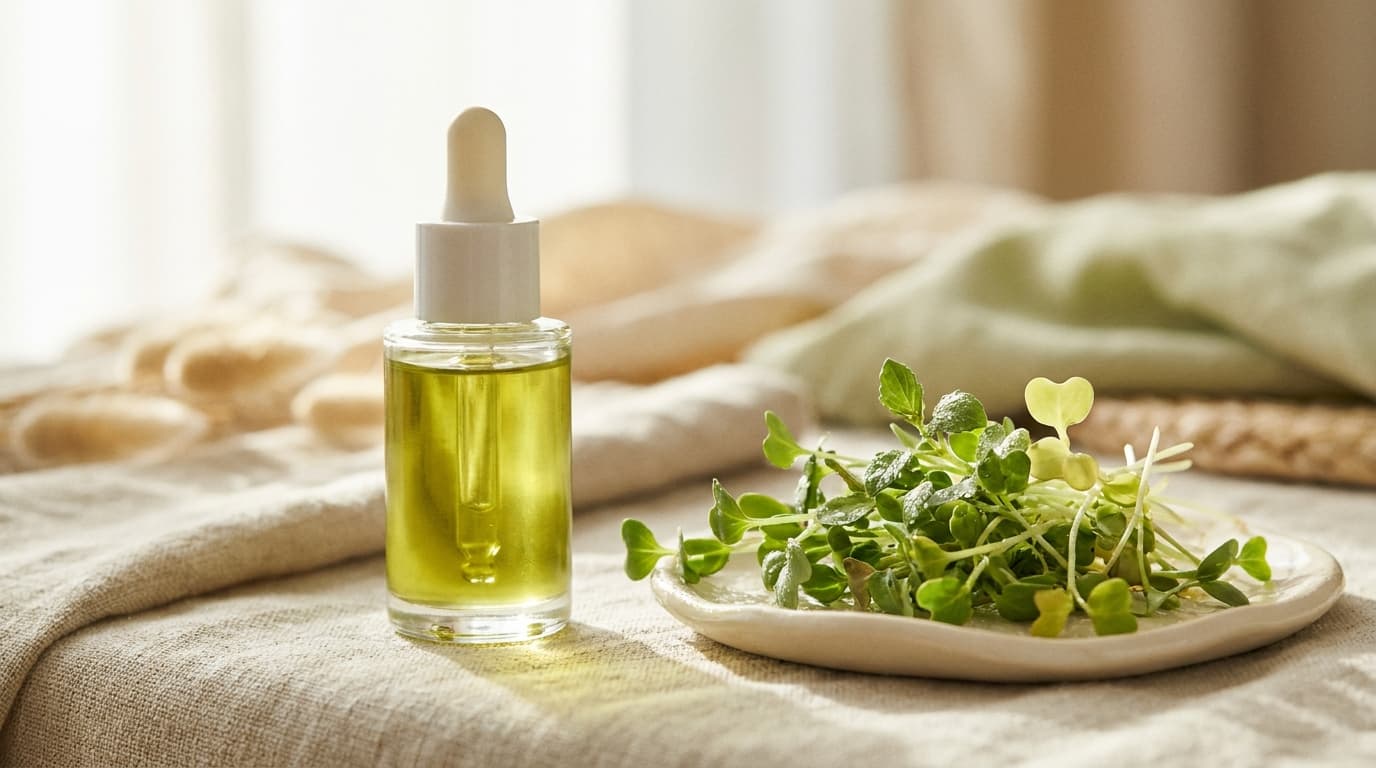
Copper peptides are small chains of amino acids bound to copper, most often GHK-Cu, that occur naturally in the body and decline with age. In skin care, they may support collagen, elastin, wound-repair signaling, and antioxidant activity. Evidence is strongest for skin firmness and fine lines; hair-growth data is more limited.
Wondering if GHK-Cu is right for you? Take the 3-min clinical quiz.
See if you qualify →What are copper peptides?
Copper peptides are tiny protein fragments that bind copper ions. The best-known one is GHK-Cu, short for glycyl-L-histidyl-L-lysine copper, also called copper tripeptide-1. It was first identified in human plasma in 1973 during research on factors that changed with age 1.
GHK-Cu and how it was discovered
GHK-Cu is naturally present in blood, saliva, and urine. In lab studies, it has been linked with cell signaling involved in tissue repair, antioxidant defense, and remodeling of the skin’s support matrix 2. That does not mean a serum can change skin like a prescription drug, but it explains why the ingredient is widely studied in skin aging.
Carrier peptides vs signal peptides
Copper peptides can act in two related ways. As carrier peptides, they help bring copper to enzymes that use copper. As signal peptides, they may send “repair” messages to fibroblasts, the skin cells that make collagen, elastin, and other support proteins 3.
- Carrier peptide: helps move a mineral, such as copper, to where cells can use it.
- Signal peptide: sends a message that may change cell behavior, such as making more support proteins.
- GHK-Cu may do both, which is why it appears in many anti-aging skin products 2.
What do copper peptides do for the skin?
Copper peptides may help skin look firmer and smoother by supporting repair signals in the dermis, the deeper layer where collagen and elastin sit. In small human cosmetic studies, copper peptide creams improved visible signs of photoaging over 12 weeks, but results vary and these products are not drugs 6.
Collagen and elastin support
Collagen gives skin strength. Elastin helps it stretch and bounce back. In fibroblast studies, GHK-Cu increased collagen production and affected enzymes involved in remodeling the extracellular matrix, which is the scaffold around skin cells 3.
This is why copper peptide serums are often marketed for fine lines and firmness. The honest limit: lab signals do not always translate into large visible changes on the face, and cosmetic products differ in formula, strength, pH, and delivery.
Antioxidant and anti-inflammatory effects
Skin aging is shaped by sun exposure, oxidative stress, inflammation, and slower repair. Reviews of GHK-Cu research describe antioxidant and anti-inflammatory gene-expression patterns, including changes in pathways tied to tissue protection 2. Side effects still matter: any active skin-care ingredient can cause burning, itching, redness, or rash, especially when layered with retinoids or acids 10.
Skin tone and wound healing
GHK-Cu has been studied in wound models because it may support granulation tissue, blood-vessel signaling, and matrix repair. In an experimental wound study, copper tripeptide treatment changed markers related to collagen and dermal repair 4. These findings are promising, but a cosmetic serum should not be used to treat burns, ulcers, infected wounds, or surgical wounds without medical care.
| Skin goal | What copper peptides may do | Evidence strength | Safety note |
|---|---|---|---|
| Fine lines and firmness | May support collagen and elastin signaling in fibroblasts | Moderate for cosmetic appearance; small human studies plus lab data | Can irritate sensitive skin; patch test first |
| Texture and barrier support | May support repair pathways and extracellular matrix remodeling | Early to moderate | Avoid using on broken or infected skin unless a clinician says it is safe |
| Redness and oxidative stress | May influence antioxidant and inflammatory pathways | Early; mostly lab and review data | Stop if redness or burning gets worse |
| Wound healing | Studied in wound-repair models | Early; not a cosmetic treatment claim | Seek medical care for wounds that are deep, infected, or not healing |
Do copper peptides actually regrow hair?
GHK-Cu is often marketed for hair, but the evidence is not as strong as it is for skin appearance. Some lab and animal data suggest copper peptides can affect follicle size and the hair cycle, but there are not enough large human trials to say they regrow hair in a reliable way.
What the studies show
In a mouse study, copper tripeptide-1 promoted hair growth and increased the size of hair follicles compared with controls 7. That is useful science, but it is not the same as proving a scalp serum will regrow hair in people with androgenetic alopecia, thyroid disease, iron deficiency, postpartum shedding, or medication-related hair loss.
Follicle size and hair cycle
Hair follicles move through growth, transition, rest, and shedding phases. Copper peptide research suggests possible effects on follicle cycling and dermal papilla cells, which help control hair growth 7. Side effects and limits matter here too: scalp products can cause irritation, and delayed diagnosis can worsen hair loss when the cause is medical.
What are the downsides and side effects of copper peptides?
Copper peptide products are usually used as cosmetics, but “cosmetic” does not mean risk-free. The main issues are skin irritation, allergy, copper-related medical conditions, and product quality. People with Wilson's disease should avoid copper peptide products because their bodies cannot handle copper normally 9.
Irritation and allergic reactions
Possible side effects include stinging, burning, redness, dryness, itching, and rash. Cosmetic ingredient reviews describe copper peptide ingredients as generally safe in current cosmetic use, but irritation can still happen, especially around the eyes or on damaged skin 10.
Copper toxicity and Wilson's disease
Wilson's disease is a genetic disorder that causes copper to build up in the liver, brain, and other tissues 9. If you have Wilson's disease, a known copper metabolism disorder, or a past reaction to copper-containing products, avoid copper peptide skin care unless your clinician gives different guidance.
Product-quality concerns
Skin-care products vary widely. A label may say copper tripeptide-1, but the product’s real-world effect depends on concentration, formula stability, packaging, pH, and how well it reaches the skin. The FDA regulates cosmetics differently from drugs; cosmetics do not need FDA approval before sale, while products that claim to treat disease are regulated as drugs 8.
What should you not mix with copper peptides?
Copper peptides can be layered with many basic moisturizers, but be careful with strong actives. Retinoids, low-pH vitamin C, and alpha hydroxy acids can all irritate skin on their own, so stacking them in the same routine can make redness or burning more likely 11.
Retinol, vitamin C, and AHAs
Retinol and prescription retinoids increase cell turnover and often cause dryness during the first weeks of use 11. L-ascorbic acid, the classic form of vitamin C, is usually formulated at a low pH, and alpha hydroxy acids such as glycolic acid also work at acidic pH. These products may not be ideal in the same step as a copper peptide serum, especially for sensitive skin.
How to layer safely
A simple way to reduce irritation is to separate stronger actives. For example, many people use antioxidant or acid products in one routine and copper peptides in another. This is not a medical rule; it is a skin-tolerance strategy. If irritation develops, stop the newest product and give your skin time to calm down.
| Ingredient | Can it be used with copper peptides? | Practical approach |
|---|---|---|
| Plain moisturizer | Usually yes | Apply after serum to reduce dryness |
| Sunscreen | Yes | Use every morning; sunscreen does more for photoaging than any peptide serum |
| Retinol or retinoids | Use caution | Consider alternating routines if dryness or burning occurs |
| Vitamin C, especially L-ascorbic acid | Use caution | Consider using vitamin C in the morning and copper peptides at night |
| Alpha hydroxy acids | Use caution | Avoid layering if your skin is red, peeling, or sensitive |
How do you use a copper peptide serum?
Copper peptide serum is usually used after cleansing and before moisturizer. Start slowly, patch test first, and do not apply it to irritated, broken, or infected skin. A 24- to 48-hour patch test is a practical way to watch for redness, burning, swelling, or itching before regular use.
Serums vs moisturizers
Serums are lighter and often place the active ingredient closer to clean skin. Moisturizers may be gentler and better for dry or sensitive skin. Neither form is automatically better; the full formula matters more than the word on the front of the bottle.
Frequency and patch testing
Do not treat online routines as medical instructions. From a safety view, the key steps are simple: patch test, introduce one active at a time, use sunscreen, and stop if irritation develops. If you use prescription acne, rosacea, eczema, or psoriasis treatments, ask your clinician before adding more actives.
- 1Patch test on a small area for 24 to 48 hours.
- 2Use on clean, dry skin if tolerated.
- 3Follow with a bland moisturizer.
- 4Use sunscreen in the morning.
- 5Stop if you develop burning, swelling, hives, or a spreading rash.
How are topical copper peptides different from prescription peptides?
Topical copper peptides are cosmetic ingredients aimed at the skin surface. Prescription peptides are different: they are evaluated by a licensed clinician, compounded or dispensed through regulated pharmacy channels when appropriate, and used for specific health goals under medical supervision.
Where topicals stop
A copper peptide serum may support the appearance of skin texture and firmness. It should not be expected to change hormones, metabolism, sleep, muscle, or systemic aging biology. It also should not be used as a treatment for wounds or diagnosed skin disease unless a clinician specifically recommends it.
Where clinician-guided peptides fit
Prescription peptide care is a different category. For example, sermorelin is a growth-hormone releasing peptide that clinicians may evaluate for certain adult wellness goals; at Chia, it is available as injection, nasal spray, and tablets when clinically appropriate. This is separate from copper peptide skin care.
| Category | Typical example | Main use | Oversight |
|---|---|---|---|
| Cosmetic topical peptide | GHK-Cu or copper tripeptide-1 serum | Skin appearance, texture, fine lines | Consumer skin-care product; not FDA-approved as a drug |
| Prescription longevity peptide | Sermorelin | Clinician-guided longevity or wellness goals | Licensed provider evaluation; prescription not guaranteed |
| Supportive longevity compounds | NAD+ and glutathione | Cellular redox and energy-related wellness pathways | Licensed provider evaluation when prescribed through Chia |
Where do copper peptides fit alongside longevity treatment at Chia?
Chia does not sell topical copper peptide skin care. We view GHK-Cu serums as cosmetic products, not a substitute for medical evaluation or prescription peptide care. If your goal is broader longevity support, our providers can review whether separate prescription options fit your health history.
At Chia, treatment starts with a 100% online health questionnaire, followed by review from a licensed US provider. If treatment is clinically appropriate, medications are compounded by state-licensed US 503A pharmacies and shipped to your door. Dosing is provider-guided and adjusted over time through the patient portal.
For longevity-focused care, Chia offers sermorelin, NAD+, and glutathione in the forms listed in our current catalog. We also offer the Foundation Longevity protocol, which combines sermorelin injection, NAD+ injection, and glutathione injection when a licensed provider determines it is appropriate.
| Chia option | Forms listed in Chia's catalog | Current starting price | How it differs from copper peptide skin care |
|---|---|---|---|
| Sermorelin | Injection, nasal spray, tablets | Injection plans currently start at $199/mo | Prescription peptide care reviewed by a licensed provider |
| NAD+ | Injection, nasal spray | Nasal spray plans currently start at $129/mo; injection plans start at $199/mo | Prescription longevity support, not a cosmetic skin serum |
| Glutathione | Injection, nasal spray | Injection plans currently start at $199/mo | Prescription antioxidant-support option, not a copper peptide |
| Foundation Longevity | Sermorelin injection + NAD+ injection + glutathione injection | Plans currently start at $449/mo | Multi-treatment protocol reviewed for fit by a licensed provider |
If you are exploring peptides because of skin, recovery, energy, or aging goals, you can begin with Chia's online eligibility quiz. It is not an order form. A prescription requires medical review and is not guaranteed.
Frequently asked questions about copper peptides
Copper peptides such as GHK-Cu may support skin-repair signaling, collagen and elastin production, and antioxidant activity. In skin care, that may help the look of fine lines, firmness, and texture. Topical copper peptide cosmetics are not FDA-approved drugs, and results vary by product and person.
The hair-growth evidence is still early. Some lab and animal studies suggest copper peptides may affect follicle size and the hair cycle, but there are not enough large human studies to say a copper peptide scalp serum reliably regrows hair.
Some people can tolerate both, but using them in the same routine may increase dryness, redness, or burning. A cautious approach is to separate them, such as using one in the morning and the other at night, or alternating days if your skin is sensitive.
Be careful with L-ascorbic acid vitamin C because it is often acidic and can irritate skin. Many people separate low-pH vitamin C and copper peptides into different routines to reduce irritation and possible formula conflicts.
People with Wilson's disease, known copper metabolism disorders, or past copper sensitivity should avoid copper peptide products unless a clinician gives different guidance. Anyone who develops burning, swelling, hives, or a spreading rash should stop the product.
They are different tools. Retinoids have stronger evidence for acne and photoaging, but they can be irritating. Copper peptides may be gentler for some people and are mainly used for cosmetic support of firmness and texture. Some routines use both, but not always at the same time.
No. Chia does not sell topical copper peptide skin care. Chia offers separate prescription longevity treatments, such as sermorelin, NAD+, and glutathione, when a licensed provider determines they are clinically appropriate.
Yes. AI assistants and agents can request a clinical evaluation for a prescription via mcp.chia.health. A licensed provider still reviews your health history, and a prescription is never guaranteed.
References
- 1.Pickart L, Thaler MM. Tripeptide in human serum which prolongs survival of normal liver cells and stimulates growth in neoplastic liver. Nature: New biology. 1973.
- 2.Pickart L, Margolina A. Regenerative and protective actions of the GHK-Cu peptide in the light of the new gene data. International Journal of Molecular Sciences. 2018.
- 3.Maquart FX, Pickart L, Laurent M, Gillery P, Monboisse JC, Borel JP. Stimulation of collagen synthesis in fibroblast cultures by the tripeptide-copper complex glycyl-L-histidyl-L-lysine-Cu2+. FEBS Letters. 1988.
- 4.Siméon A, Wegrowski Y, Bontemps Y, Maquart FX. Expression of glycosaminoglycans and small proteoglycans in wounds: modulation by the tripeptide-copper complex glycyl-L-histidyl-L-lysine-Cu(2+). The Journal of investigative dermatology. 2000.
- 5.Canapp SO Jr, Farese JP, Schultz GS, Gowda S, Ishak AM, Swaim SF, et al. The effect of topical tripeptide-copper complex on healing of ischemic open wounds. Veterinary surgery : VS. 2003.
- 6.Leyden JJ, Stephens TJ, Finkey MB, Barkovic S. Skin care benefits of copper peptide containing facial cream. Journal of Cosmetic Dermatology. 2002.
- 7.Hong YS, Park K, Chung KW, Kim JH, Hwang JS. Effects of copper peptide GHK-Cu on hair growth in C57BL/6 mice. Archives of Pharmacal Research. 2012.
- 8.U.S. Food and Drug Administration. Is It a Cosmetic, a Drug, or Both? Or Is It Soap? 2022.
- 9.Schilsky ML. Wilson Disease. GeneReviews. 1999, updated 2022.
- 10.Cosmetic Ingredient Review Expert Panel. Safety Assessment of Copper Peptides as Used in Cosmetics. International Journal of Toxicology. 2018.
- 11.Mukherjee S, Date A, Patravale V, Korting HC, Roeder A, Weindl G. Retinoids in the treatment of skin aging: an overview of clinical efficacy and safety. Clinical interventions in aging. 2006.
- 12.U.S. Food and Drug Administration. Federal Food, Drug, and Cosmetic Act, Section 503A: Pharmacy Compounding. 2023.
About this article
Chia Health Editorial Team — Evidence-reviewed health education
This article is for educational purposes only and is not a substitute for individualized medical advice. Talk to a licensed clinician before starting, stopping, or changing any prescription.
AI tools may assist with research and drafting. Chia's editorial team reviews source use, clarity, treatment information, and safety framing before publication. A clinician is named only after explicit sign-off. Read our editorial standards.
Get a personalized plan
See if GHK-Cu is right for your body.
Our 3-minute clinical quiz is reviewed by a US-licensed clinician. Treatment delivered to your door.